I was reflecting on one of my favourite Zig Ziglar quotes:
Logic can’t change emotion, but action will.
That quote stuck with me.
It made me wonder—how does this apply to trading?
Fixing a Deep-Seated Trading Problem
For years, I struggled with scaling into losing trades—until I found a way to fix it.
No matter how much I logically understood that adding to losers was a bad habit, I kept doing it.
Emotion overruled logic every time.
But I didn’t fix it by thinking harder—I fixed it by taking action.
I started researching breakout trading, specifically second-leg entries.
Every day, for hours, I drew arrows on charts, marking second legs. It became second nature. Any time I looked at a chart, my brain automatically spotted second legs. HTF, LTF, where they worked, where they failed.
I tracked them in spreadsheets, I obsessed over the perfect scale-in ideas. none of which meant a thing.
I was Mr Miyagi’ing myself. Ah Karate Kid.

What does that mean? The magic was working but I didn’t know it yet.
Then I started to SPLIT my own trades when I did my trade review.
Turns out, if I only took second-leg breakouts, for the sake of the potential-haters, my win rate was at least 80%. Mostly more.
That changed everything.
I stopped so many reversal trades.
I stopped counter-trend trades.
Now, if I’m in a losing trade and a breakout goes against me, I don’t even think about scaling in—I just close it. The habit is gone.
I can still feel it there haunting me, but I ignore him.
Action rewired my brain.
What’s Holding You Back From Trading Well?
Here are some common emotional challenges traders face—and the actions that can change them:
1. Closing Winning Trades Too Early
You take a reasonable trade, but the moment it moves against you, fear creeps in. You exit early—only to watch price hit your target.
Try this:
- Instead of fully closing, reduce size. Exit most of your position, but keep a micro contract (MES if trading ES). Or close minis and BUY a micro. This keeps you in the trade while removing risk.
- Step away. Let your stop and target do their job—what Al Brooks calls the Walmart trade.
- Record how often the trade went without hitting your stop:
- 1 point more
- 5 points more
- 10 points more
- 20 points more.
2. Always Wanting to Trade Countertrend
You know trading with the trend has a higher probability, but something inside you always wants to fade the market. Low risk aye?
Try this:
- Enter small with the trend and watch it work. You’ll likely end up wishing you traded it bigger—training yourself to see the power of trend trading.
- Ignore that ONE time it went 4R. You know the one….
3. Placing a Wide Stop You’ll Never Let Get Hit
You set a wide stop, thinking you’ll hold… but halfway through the trade, you know you won’t let price reach it.
You are kidding yourself – and that’s okay.
The fun part of a wide stop is it almost NEVER gets hit. It’s like a safety net.
Try this:
- If you realize mid-trade that you’ll never let your stop get hit, close most of your contracts immediately—keep only one to see how it plays out.
- Start to measure the RR on the trade where you stopped yourself out. How can you have a 20pt target and a 5pt risk? Which was where you closed. It doesn’t make sense.
4. Getting Chopped Up in a Tight Trading Range
You take multiple small losses in a choppy market, getting frustrated and revenge trading. Reversing. Then reversing your reversal – I’m dizzy!
Try this:
- Only fade breakouts—if you’re going to trade the range, trade with range logic.
- Only scalp—if you’re stuck in a range, take profits on strong bars instead of forcing trend trades and ENTERING on strong bars.
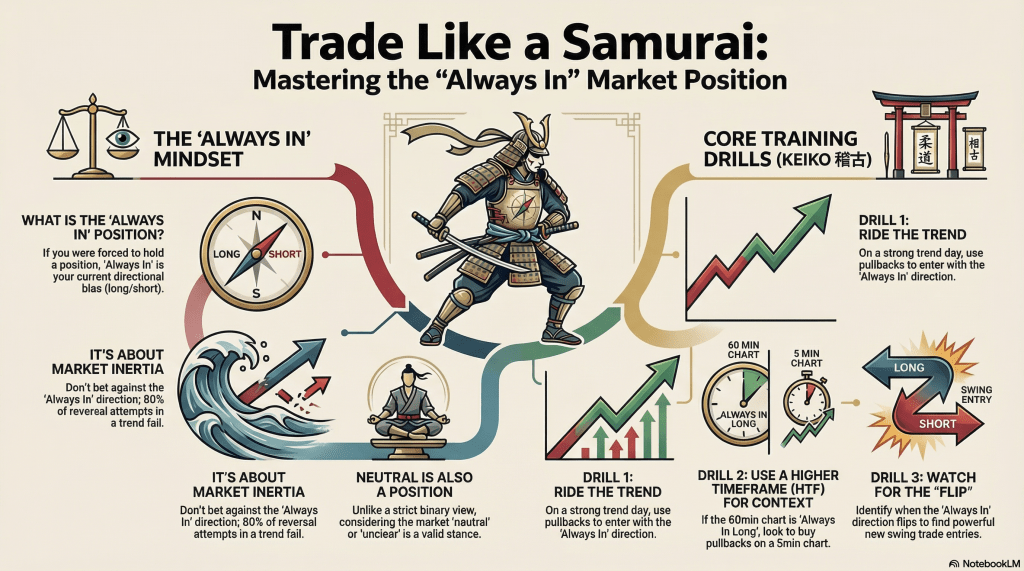
- You can SWITCH directions, but don’t SWITCH the ALWAYS IN direction. You are in a Trading Range. Wait, or Scalp. Probably wait.
The Power of Active Patience
Most trading mistakes come from emotion, not logic.
But for every emotional mistake, there’s an opposite action that can retrain your habits.
I call it active patience—not just sitting back and hoping to improve, but deliberately changing your behavior through action.
Zig Ziglar was right—logic won’t change emotions, but action will. And in trading, action is everything.



 Zen Trading Tech
Leave a comment