
Key Takeaways
- Process over outcome – The first goal isn’t to win trades; it’s to execute correctly every time.
- A good trade = correct process. A bad trade = incorrect process. Change personal views into practical views. I can’t control what the market does, only what I do.
- Resetting isn’t mental—it’s proven by action. You don’t “let go” by telling yourself you have. You prove it by taking the next trade correctly.
Introduction
In this post I will discuss a trading day that went from bad to good to bad to good again.
I will discuss strategies for observing and changing our mindset to be more in sync with both the market and our internal centre.
My intention it to give traders a different way to grade performance and also to prove when a reset has occured.
The Same Mistake, Three Times in a Row
The other day, I had a rough start.
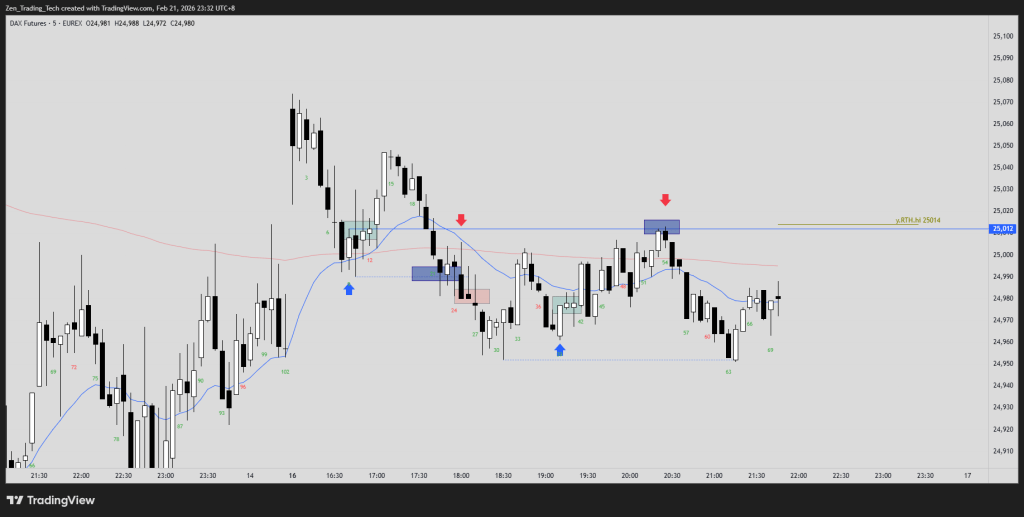
I was trading DAX in the European session, and I took three losses in a row.
But here’s the truth: These weren’t three separate mistakes. They were the same mistake, three times in a row.
The market was in a tight trading range, and instead of adjusting my approach, I kept trying to force trades that weren’t there. The mistake wasn’t that the trades lost—the mistake was that I wasn’t reading the market correctly and adjusting my execution.
So, after three strikes, I did something that past me wouldn’t have done: I stopped trading. I shut my screen down and walked away.
Not because I was upset, but because I recognized I wasn’t following my process.
Coming Back to Process in the US Session
I used to very upset with myself and the market and well, anything else I can think of.
I was reflecting how that has changed.
When I came back for the US session, I wasn’t worried about resetting. I proved it when I took my first trade.
I didn’t come back looking to “make back losses.” I came back focused on trading my process correctly.
And here’s what happened:
My first two trades? Executed correctly. They happened to be winners. But the traders equation was correct.
Here We Go Again – The Biggest Loss
Then came the third trade. I broke process.
This trade should have been a small loss, but I hesitated. I convinced myself to scale in, even though my entry was already flawed.
And before I could exit, the market dropped hard, turning what should have been a manageable loss into a much bigger loss.
This had nothing to do with the market. It was my process failure.
I had brought my earlier losses back into profit AND THEN back to where I was at the end of the prior session.
That’s annoying.
At that moment, I was frustrated—not because I lost, but because I knew I had abandoned my own plan.
The True Reset: The Final Trade
After that big loss, I stepped away. Swore a little. Thought about quitting for the day.
I stood on my balcony breathing in some fresh air and laughing at how easy it is to get carried away in this business.
How easily we can forget the goal!
Then, 15 minutes later, I saw one of my favorite setups:
A late leg breakout attempt low in a trading range day.
Now, the old me would have been in no state to take this trade.
- I’d be emotionally attached to my last loss.
- I’d hesitate, worried about taking “another” loss.
- I’d start questioning my edge.
But here’s what changed:
I asked myself one question—am I actually reset?
Not in my emotions, but in my actions.
Because the proof of a real reset isn’t whether I tell myself I’m calm.
The proof is in whether I take the next trade correctly, with the right entry, the right stop, and the right execution.
So I placed the trade exactly as I should have.
This time, I followed my process.
And yes, it was a big winner. But the important part? I was already free before I entered.
Old Me vs. New Me: The Difference in Process
| Old Me (Process Breakdown) | New Me (Process First) |
|---|---|
| Stayed at the screen frustrated. | Shut the screen down, walk away. |
| Took three losses from the same mistake. | Identified the mistake, adjusted my approach. Don’t repeat them one after the other. |
| Increased size after losses. | Kept size consistent with traders equation and volatility, focused on quality setups. |
| Tried to “make back” losses. | Took each trade independently, without attachment. |
| Hesitated, scaled into a bad trade. | Follow exit procedure |
| Felt good because of a winning trade. | Felt good because I executed correctly. |
Tiger Woods’ “Tee Rule” and Why It Works in Trading
Tiger Woods has a rule for resetting after a bad shot:
“I can think about it until I walk off the tee. Then it’s gone.” – Tiger Woods
That’s exactly how a trader needs to operate.
A good trade isn’t a winner—it’s one where I follow my process.
A bad trade isn’t a loser—it’s one where I break my process.
So the reset isn’t just mental—it’s in what I do next.
You can stew over it but when its time to assess the next setup and take a trade – that has to be gone.
Give yourself some time to be compassionate.
How Traders Can Apply This
- Recognize when you’re repeating mistakes.
- Two to three losses in a row? Ask yourself: Is this really three different mistakes, or the same mistake three times?
- Detach from past trades—good or bad.
- If you hesitate because of a previous loss, you haven’t reset.
- If you take a trade just because you’re on a winning streak, you haven’t reset.
- Take a break from the screen – day, week, more.
- The real test: can you take the next trade correctly?
- The next trade is the only proof of whether you’ve reset.
- If you adjust your size, avoid risk, or hesitate, you’re still attached to the past.
Final Thoughts: Winning and Losing Don’t Matter—Process Does
At the end of the day, I don’t judge my trading by P&L. It is nice to look at it. But it tells me very little about my risk control and whether my trades made sense and were in sync with the market.
I judge it by how well I followed my process.
- I started the day breaking my process (and lost).
- I reset and followed my process (and won).
- Then I broke my process again (and took a bigger loss than I should have).
- Finally, I took the next trade properly—and that was the moment I truly reset.
The real test wasn’t whether that last trade won.
The real test was: did I execute correctly, regardless of the outcome?
That’s the difference between the trader I used to be and the trader I am now.
I hope you enjoyed reading this post.
Please let me know in the comments if it resonated with you.
Tim F



 Zen Trading Tech
Leave a comment