Key Takeaways:
- Homework is the fastest way to improve as a trader.
- Huge appreciation to Precog for submitting this—less than 1% of traders seek feedback on their charts.
- My feedback isn’t special, but it might help you consider alternative trade placements.
- Reviewing this chart also helped me validate my own rules—and I wouldn’t change any at this time. 🙂
- Key Takeaways:
- Introduction:
- Beginners Start Here:
- Markups:
- The Function of Bar Counting:
- Theory from Al Brooks:
- Chart Breakdown:
- Other Notes:
- Next Steps:
- Additional Tips:
Introduction:
- High 1 (H1) and High 2 (H2) entries are essential tools for traders aiming to identify high-probability pullback opportunities within trends. These setups provide a structured approach to timing entries and minimizing risk.
- In this article, readers will learn the importance of H1 and H2 entries, how to identify them, and practical tips to improve their trading consistency.
- This guide is suitable for traders at all levels, from beginners looking to understand the basics to experienced traders refining their strategies.
A Big Thank You to Precog for the Effort in Sending in the Chart
Beginners Start Here:
- Watch Al’s videos.
- Read Al’s book – Focus on the Trading Ranges chapter, specifically the section on bar counting.
- Watch my videos:
- H2 pullback
- Leg counting
- Chart review
Markups:
High 1 (H1) and High 2 (H2) entries relate to pullback setups. It’s important to practice distinguishing between those that trigger and those that don’t.
- Sometimes I place the arrow on the bar that sets up the entry—just remember that it needs to trigger to confirm trade potential.
The Function of Bar Counting:
- Helps identify entries into trending moves after a pullback.
- Requires clear rules to distinguish between trends and trading ranges.
- Example: An H1 long in a bull trend is good; an H1 long in a trading range is risky.
- Understanding reversals and follow-through is crucial.
- Recognizing swing points and their breakout behaviors is essential for accurate counting.
Theory from Al Brooks:
According to Al, there are several ways to get long in a trend (refer to Book 2):
- First, confirm a trend.
- The bottom of a trading range is not a trend.
- Entry methods:
- Buy on a stop, one tick above a prior high.
- Buy an H1 (pullback).
- Fade a bear breakout of the pullback by buying below the H1.
- Buy an H2 (2-legged pullback), preferably above a bull bar and the moving average (MA).
- If you miss the pullback entries, consider going long one tick above the high.
Tip: Pick one method and practice it consistently.
Chart Breakdown:
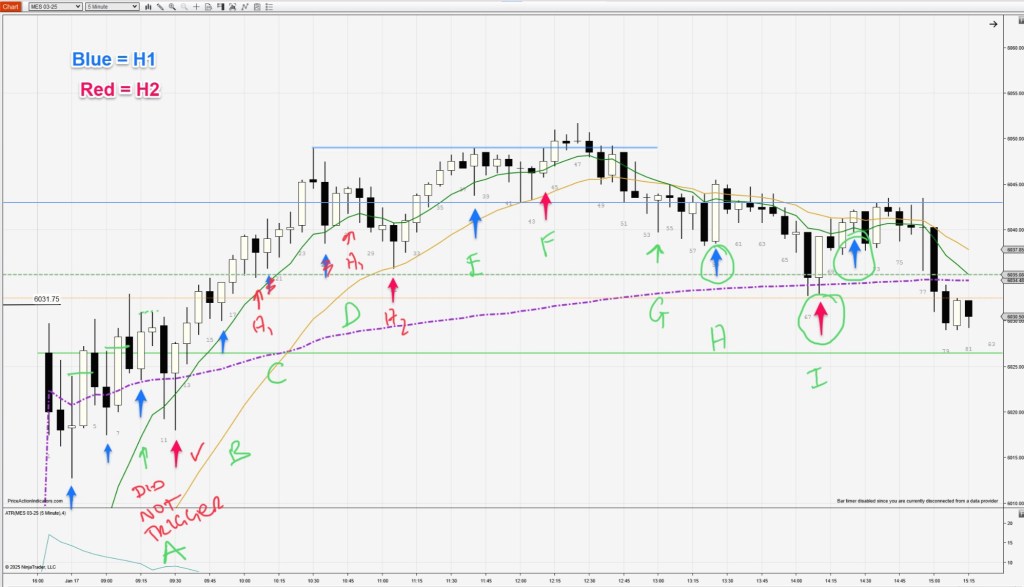
Gap Up with a Trading Range Open – Above Both MAs, Treat as Bull Channel
- A (B9): H1 did not trigger, but some traders may still count it.
- B (B12): Can be considered an H1 or H2 buy signal.
- C (B19): Arrow should be on the previous bar; triggered on the next bar, though weaker as it’s a bear bar.
- D (B27): H1 above the small bull inside bar. Since it’s the third H1 setup, it’s likely the last—best treated as a scalp.
- E (OB): I personally don’t count outside bars (OBs), as order flow is unclear.
- F (B45): Valid H2, marking the second attempt to resume the trend.
- G (B54): H1 setup, but a potential fade. After three legs up and a failed breakout, consider looking for L2s.
- H (B61): H2, but too large and near the MA—better to wait or fade.
- I (B72): H3, wedge pullback, or H2 on a higher time frame (HTF).
Other Notes:
Trend Shift Considerations:
If the bull trend ends, marking H1 and H2 helps, but they are not as effective outside of bull trends. Consider tracking H4 entries for higher time frame setups.
Swing Low Breaks:
After three legs up, a break led to a bear micro channel down to G.
Next Steps:
- Review these notes and compare them with your charts.
- Remember, trading is about probabilities, not perfection.
- Focus on one concept per chart to avoid overload.
- Develop a grading system for H1 and H2 entries:
- H1 above a bear bar vs. a bull bar.
- H2 weak vs. strong setups.
- Early vs. late leg entries.
- Extend the process to L1 and L2 (down moves) and repeat step 3.
- Incorporate L1 and L2 analysis into the same chart:
- Expect some initial confusion.
- Much of the chart will present 50/50 setups—assume channels or trading ranges in those areas.
Additional Tips:
- Common Mistakes to Avoid: Avoid counting bars in TTR or without confirming trends.
- Visual Aids: Use annotated charts for clarity. Particularly different opens.
- Engagement: Share your thoughts in the comments or join our discussion forum.
Thanks again to Precog for the effort and for submitting their work!
Tim



 Zen Trading Tech
Leave a reply to Lloyd Cancel reply