- Volatility up — size down
- IBS — how did the day before close?
- Gap direction
- Open type
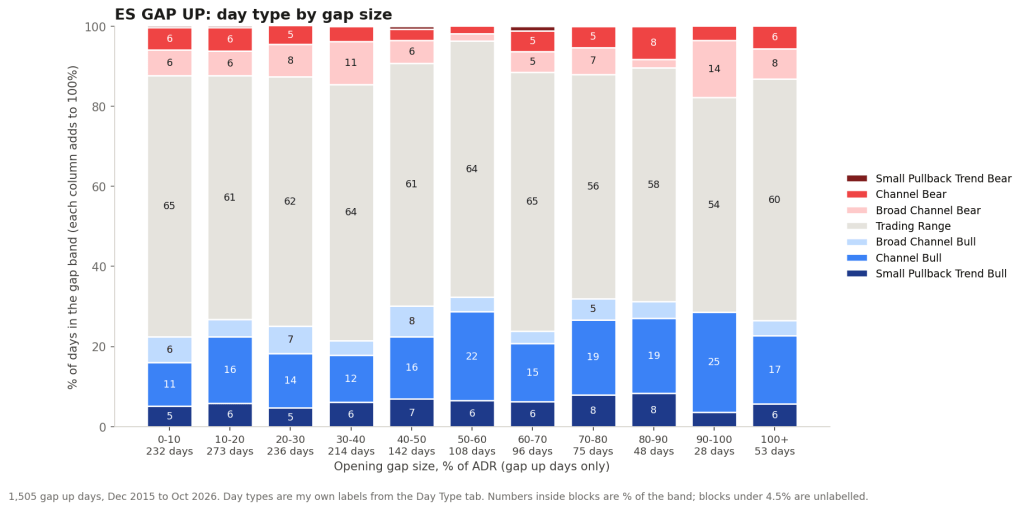
- Gap size, by direction
- Stacking the reads
- What the data told me to ignore
- My checklist for today
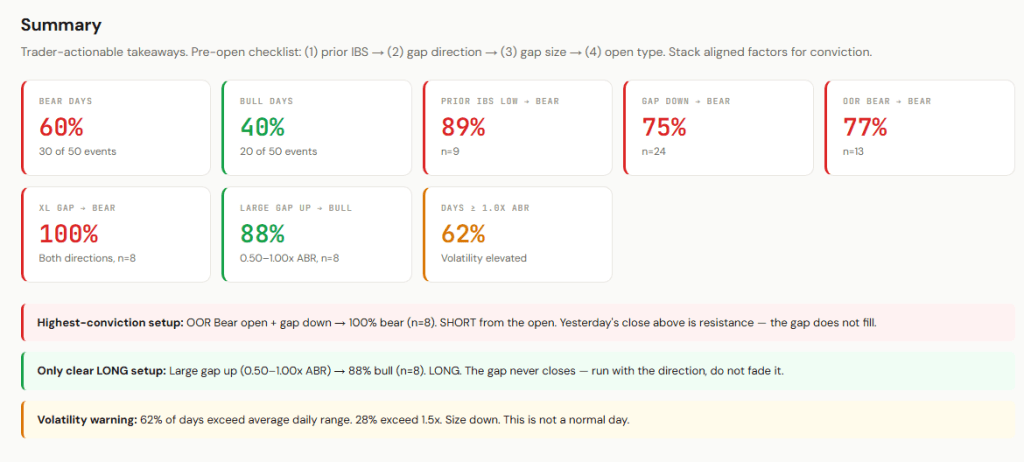
I just finished a study on every scheduled FOMC meeting since December 2019.
Fifty events, looking at how the DAX reacts the next morning. Today is the first day I’ll trade with it.
Caveat going in: 50 events isn’t a lot. The 2022–2023 hiking cycle is a big chunk of the sample.
So this is me sharing the research as I have it, not me telling you how to trade these days — I haven’t traded one with this framework yet. We’ll find out.
Quick framing: the Fed announces around 20:00 Frankfurt time, after the DAX is closed. The DAX wakes up the next morning to the news. So when I say “the day before” in this post, I mean the day that contained the Fed statement. The “reaction day” is the morning open after that.
The framework I use for any probability study: 60% or above is higher probability scalp, below 40% is tradeable as a swing.
Volatility up — size down
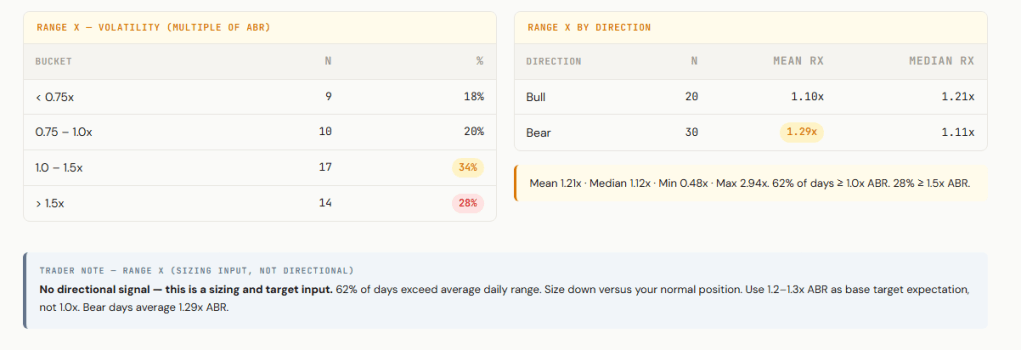
Before any directional read, what the data shows is that these days run hotter.
62% of reaction days exceeded average daily range. Mean range was 1.21x ABR. 28% ran to 1.5x ABR or more.
So likely today, I’m sizing down and looking to add.
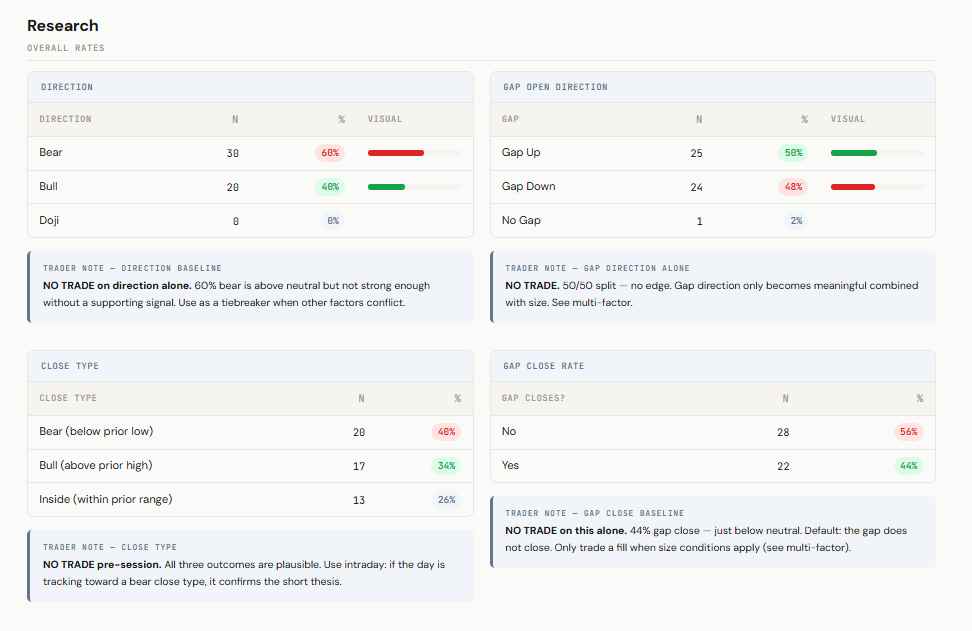
There’s also a mild bear lean in the dataset (60% bear vs 40% bull, no dojis). I’m noting it as a tiebreaker only — not a trade on its own.
IBS — how did the day before close?
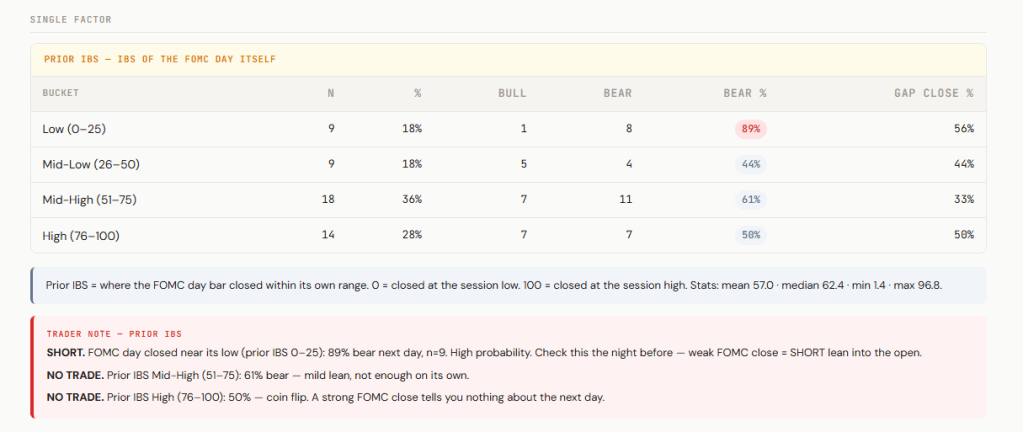
The IBS of the day before — where it closed within its own range. 0 = closed at the low, 100 = closed at the high.
- IBS 0–25 (closed near the low): 89% bear, n=9. SHORT bias.
- IBS 26–50: 56% bull, n=9. NO TRADE.
- IBS 51–75: 61% bear, n=18. NO TRADE — sits in the neutral-to-mild range.
- IBS 76–100 (closed near the high): 50%, n=14. NO TRADE.
Yesterday 29th April 2026 closed between 16 – 28 IBS depending on which session you trade. 28 was the XETRA session.
So only the bottom bucket gives a signal. A weak close on the day that heard the Fed leans short for the next session. A strong close says nothing — the market that closes high after the Fed statement is a coin flip the next day.
Gap direction
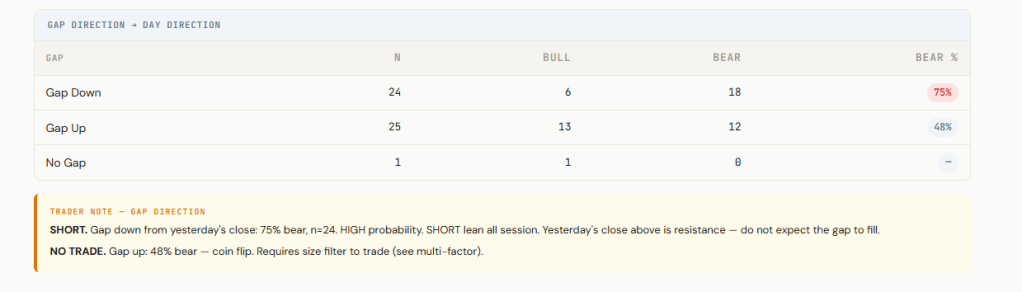
The DAX gapped on 49 of 50 reaction days. The gap is almost certain. The direction is the read.
- Gap down: 75% bear, n=24. SHORT bias. Yesterday’s close (above the open) is resistance. Don’t expect it to fill — gap closes 56%.
- Gap up: 48% bear, n=25. NO TRADE on direction. Needs a size filter.
Open type
Open type is whether today’s open is inside yesterday’s range, above its high, or below its low.
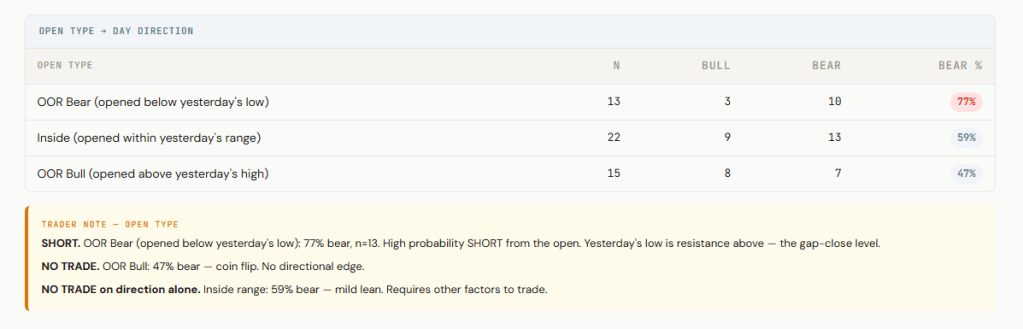
- OOR Bear (opened below yesterday’s low): 77% bear, n=13. SHORT bias.
- Inside-range open: 59% bear, n=22. NO TRADE — mild lean, not enough on its own.
- OOR Bull (opened above yesterday’s high): 47% bear, n=15. NO TRADE.
OOR Bear works as a directional read. OOR Bull doesn’t. The mirror doesn’t hold here.
Gap size, by direction
Let’s look at gap direction, gap size and whether it gives a clue on day direction.
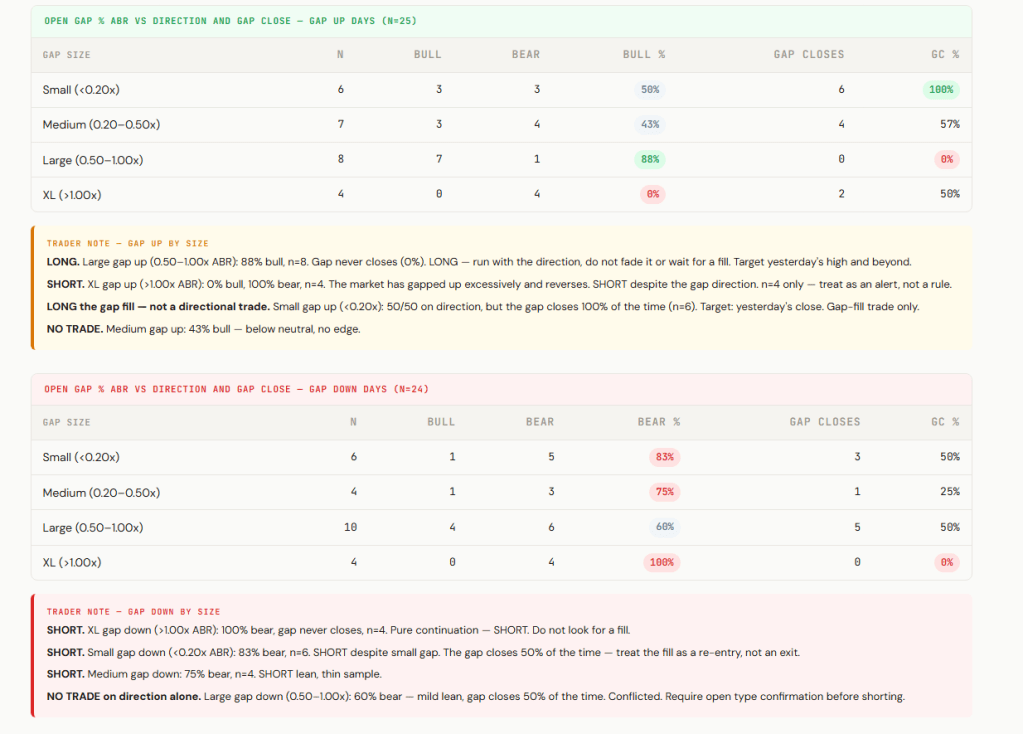
Gap up days (n=25):
- Small gap up (<0.20x ABR): 50% direction, n=6. NO TRADE on direction. But gap closes 100% — that’s a gap-fill trade, target yesterday’s close.
- Medium gap up (0.20–0.50x): 43% bull, n=7. NO TRADE.
- Large gap up (0.50–1.00x): 88% bull, n=8. LONG bias. Gap closes 0% — don’t trade a fill. Run with the direction.
- XL gap up (>1.00x): 0% bull, n=4. SHORT bias despite the gap being up. n=4 is thin — treat with caution.
Gap down days (n=24):
- Small gap down: 83% bear, n=6. SHORT bias. Gap closes 50% — the fill is an entry, not an exit.
- Medium gap down: 75% bear, n=4. SHORT lean, n is thin.
- Large gap down: 60% bear, n=10. NO TRADE on direction alone — gap closes 50%, conflicted. Need open type confirmation.
- XL gap down: 100% bear, n=4. SHORT bias. Gap never closes.
Stacking the reads
The reads are independent so they can stack. The clearest stack in the dataset:
OOR Bear + gap down: 100% bear, n=8. Of the 13 OOR Bear opens, 8 also gapped down. All 8 closed bear. Two reads agreeing — both pointing short. n=8 is thin, but the alignment of open type and gap direction is the highest-conviction setup the study produced.
What the data told me to ignore
- Prior bar direction: 60% bear after a bull day, 63% bear after a bear day. Same as the dataset baseline. No edge.
- Gap direction alone, when the gap is up: 48% bear. Gap up needs the size filter to give anything.
My checklist for today
- 62% chance of an extended-range day. Position size accordingly.
- Where did yesterday close in its range? Bottom quarter (IBS 0–25) = SHORT bias.
- Gap direction at the open: gap down = SHORT bias. Gap up = wait for size.
- Open type: OOR Bear = SHORT confirmation.
- Gap size after the open: large gap up (0.50–1.00x ABR) = LONG. XL gap either direction = SHORT. Small gap up = gap-fill trade only.
Cleanest sub-buckets are n=4 to n=9. I’ll re-run this study every year as more events come in.
First trade with the framework is today. I’ll report back.
Happy trading!
Tim
Zen Trading Tech



Leave a Reply