You hear that all the time from traders. So in this post let’s talk about the why?
This post is for the trader stuck in a cycle — doing well for a while, building the account, feeling confident… and then blowing it up. I was there for a looooong time. Several times.
Here’s what I found in my own trading, and how I fixed each one. I hope it helps you keep what you’ve made and develop confidence in your own abilities.
The Overnight-Expert Fantasy
Before we get into the specifics, let me talk about the hidden cause behind mine!
One of the biggest drivers of my account blow-ups was a belief I didn’t even know I had: I’ve convinced myself I’m about to become a pro trader. Today.
I was reading a personal development book and it said you should describe what your future state is like. I started writing in the present tense, even though I wasn’t anywhere near a good trader, but writing about being a professional price action trader.
I wrote half to one page and then I re-read it and it was ridiculous. I had the most ridiculous sentence in the world and I’m going to tell that to you now:
“I’m a professional price action trader, I can trade any bar, any time, any direction and make money.”
Epic effing lol.
You can’t even build a computer with all the advanced AI in the world that can do that.
Here I am trying to learn a skill and my standard that I’m trying to reach is actually impossible. Nobody trades like that. In fact you couldn’t find any sport, any mental discipline, any job with that kind of approach.
Maybe in a video game but in human reality we develop skills in limited areas and outside of those areas the skills drop off. Short lifespan, short attention span, limited amount of energy and time to develop skills in certain areas and ignore the rest.
My mindset was breeding pressure, urgency, and oversized trades. So now I’m treating every session like it’s the audition of my life. And when the market doesn’t cooperate? I force it.
Truth is: improvement is a process. My Kung Fu Sifu said to me once:
“Perfect life is not hurrying to reach perfect — hurry is never perfect. It always brings its friends stress, worry and fear! Enjoy to develop towards perfect, is perfect.”
When I began practising accepting the fact that I’m not going to be good by this weekend — suddenly the stress reduced, the enjoyment increased, and my improvement became steadier.
Today is another step in the right direction. It might not look like it’s forward but if I keep turning up and I keep following the process, I will improve.
Keep that in mind as you read through the rest of this post.
Conditioning — Physical, Mental, Emotional
Most of my blow-ups happened when I was tired, stressed, or out of routine. Not when the market was hard — when I was depleted.
Physical: Stiff and locked up from sitting too long. No movement, no stretching, no gym. The body was screaming and I was ignoring it. You need to move — cardio, weights, a walk outside — something to refresh the body before you ask it to perform.
Mental: Shortening sleep cycles from stress, no reset. Too wired or too foggy. Not enough variety in mental stimulation and way too much screen time. Over-charting is real.
Emotional: Big arguments at home, stress at work — these bleed into your trading whether you admit it or not. The more relationships you’re involved in, the more outside influences will affect your performance. Becoming a trading hermit creates its own stress — loneliness. Either way, finding balance and accepting that life will come into your trading is part of the game.
Build routines that protect your state — gym, stretching, walking, massage, rest and recovery. If you’re not conditioned, don’t trade. Discipline keeps what you have developed.
Sleep: my biggest blowups happened on Thursday and Friday and it took me a long time to realize this. I would trade on Monday and everything would be okay. Trying to sleep after trading takes time so I would shave an hour or more off of sleep. On Tuesday I would have a bit more coffee and shave off another hour of sleep. You can see what happens on Thursday and Friday. If you have lost an hour plus of sleep every day up to now, you are basically short half a day to a day’s rest. No wonder Thursday and Friday are so bad!
Not enough sleep? I don’t trade. It’s one of my most profitable rules.
The Martingale Effect — Repeating Mistakes
Lose, then double down. “It’ll work this time.”
The problems with this are simple.
One -markets have inertia, that means they will keep doing what they are doing.
Two, I don’t have infinite money.
Three, I’m wrong! Deal with it. Al Brooks has a rule I come back to all the time: two failed attempts? Stop. Stop reentering. There is no 3rd time lucky in trading. My read is wrong.
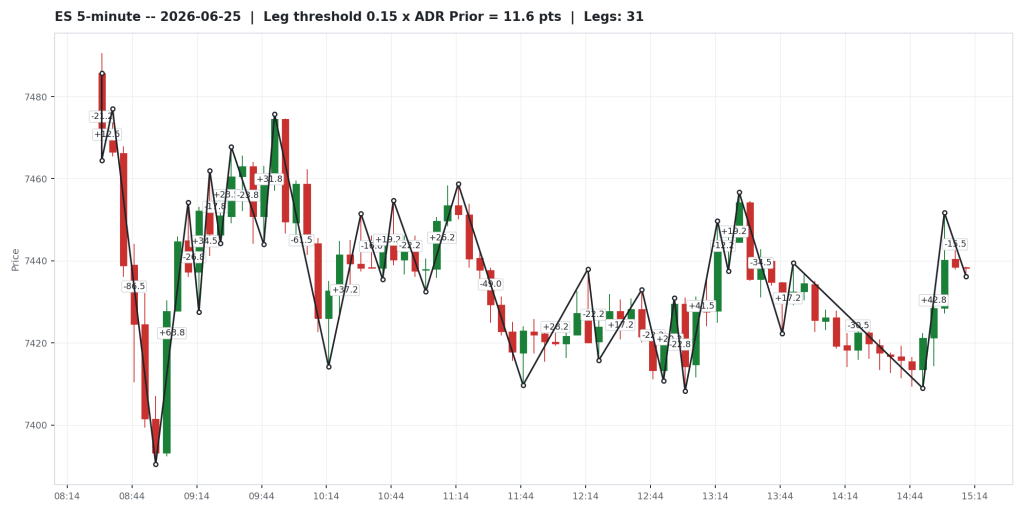
The problem is not that it can’t work. The problem is that I’m so out of sync I won’t be able to take the trade when it appears. Look at the example below.
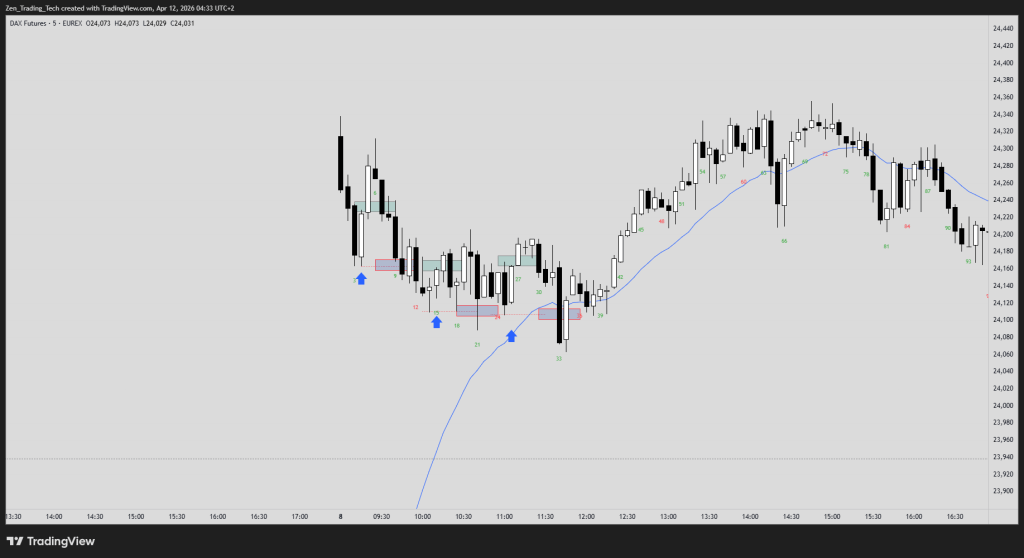
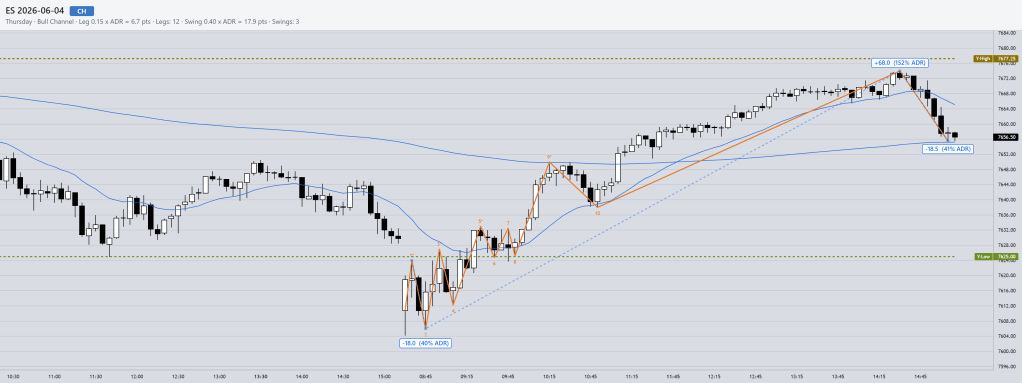
This one is sneaky. A spike down happens and instead of taking a second leg, you try to buy the reversal. Doesn’t work. You try again. Doesn’t work. Surely it’ll work now.
Instead of continuing to buy all the way down, you pause. It’s a gap up. You’re waiting to see what happens at the moving average after your two losses. You wait: are we going to break to the downside or the upside? Now you have got high-probability trades for a bull spike.
After so many consecutive losses, buying you won’t be physically able to hit buy any more even though the probability tells you to.
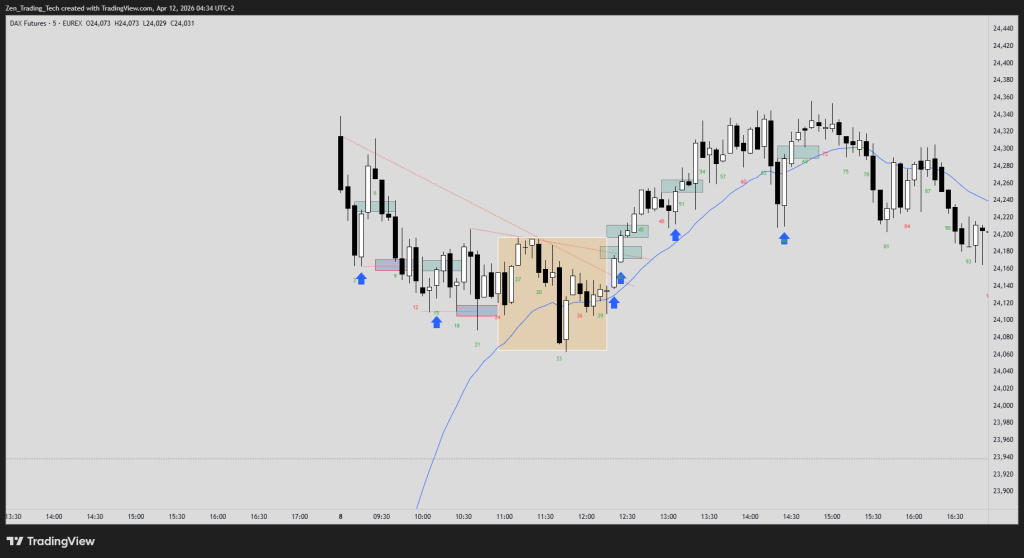
Trade the phase you’re in, not the one you want.
Big Losses Cause More Big Losses
You take one big hit — and then you want it back now.
There’s this uncomfortable feeling that I have to get back to whole. I have to undo my loss. The market has taken something from me.
So you start forcing trades, oversizing, holding scalps for swing targets. You’re not trading the market anymore. You’re trading your P&L. And that never ends well.
Instead: accept the loss, trade the market structure in front of you, and work your edge back to green. A big loss is one trade. The blow-up happens because of what you do after the big loss. That’s where the real damage comes from.
For example you take a high-probability trade and it doesn’t work. We will probably be in a trading range now for several more bars and that means you can’t trade it the same way you traded the high-probability setup.
Here is an example of an immediate switch to potentially recover your loss
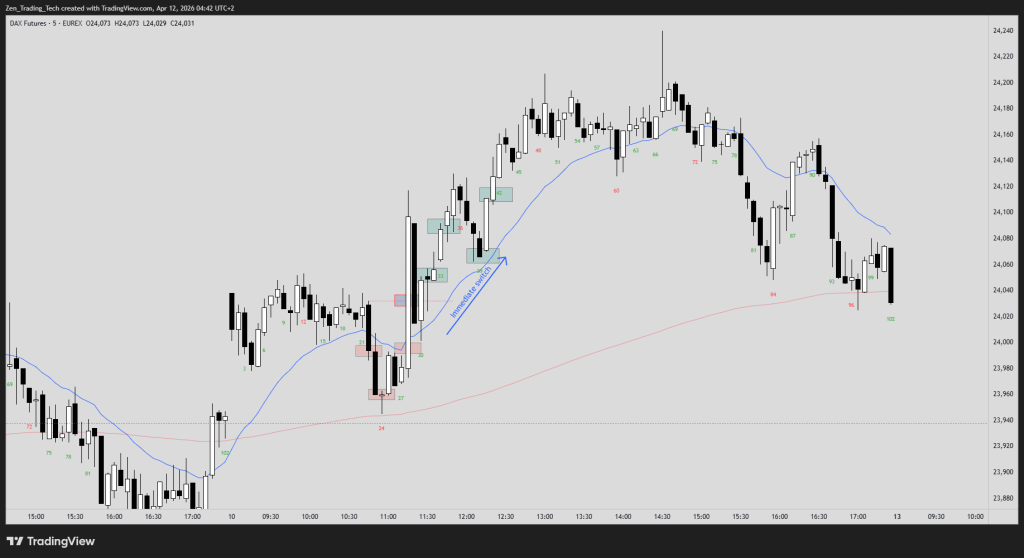
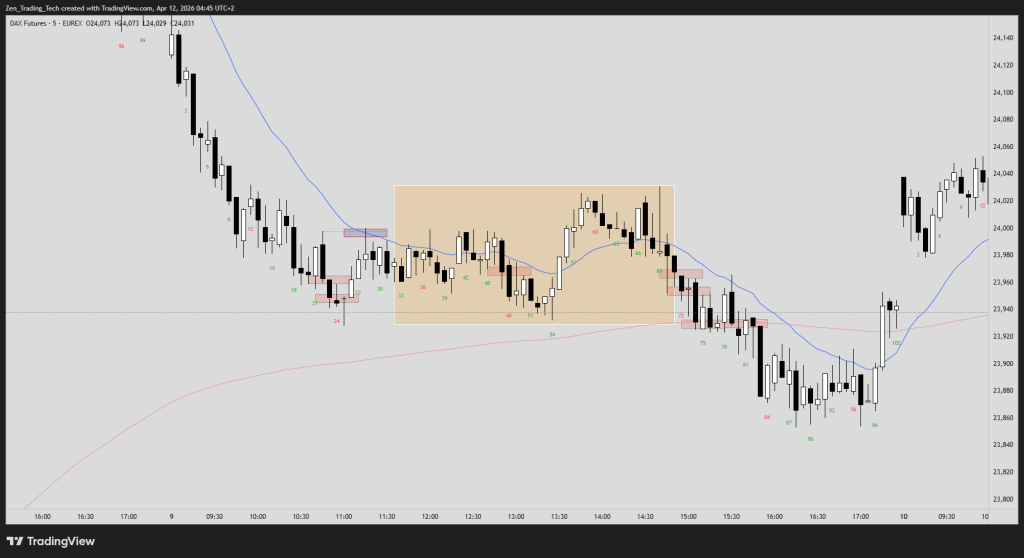
Here, late leg, went too far too fast, have to wait to take swing trades again, can’t recover that loss in the trading range very easily.
Not Waiting for Your Setup
You know what your setup looks like. You’ve studied it. You’ve drilled it. But when the market opens, you don’t wait for it.
Or worse — you trade something you’ve never tested. Something that looked interesting on someone else’s YouTube channel. That’s not trading. That’s gambling with extra steps.
Even great setups fail. That’s normal. But if you’re taking trades that aren’t even in your playbook, you’ve got no edge at all. Wait for your setup.
Unreasonable Expectations
Wanting 2R from a late entry in a trading range (TR)? Unlikely.
You have to learn what kind of market you’re in and what it’s likely to present to you. In trends, you get shallow pullbacks and breakout continuation — the market is generous with runners. In trading ranges, you get deep pullbacks and reversals — scalp targets are the realistic play. If you don’t take profits relatively quickly, everything goes back to breakeven.
Match your target to the structure. Match your entry to the likely market cycle.
Unaware of Volatility
Bar size today isn’t bar size yesterday. The open can be wild — 20-point bars instead of 5. If you’re using the same position size and the same mental stop, you’re already off-balance.
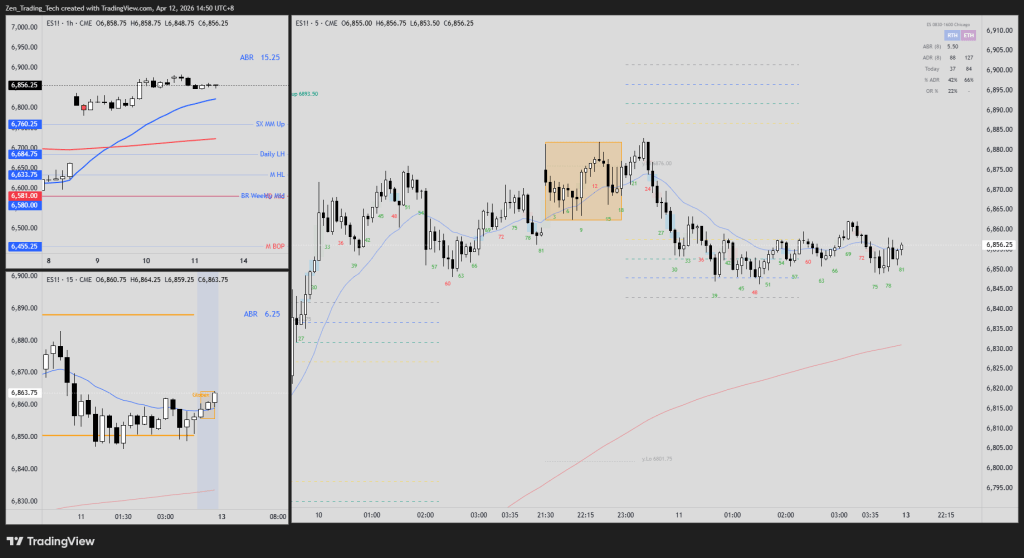
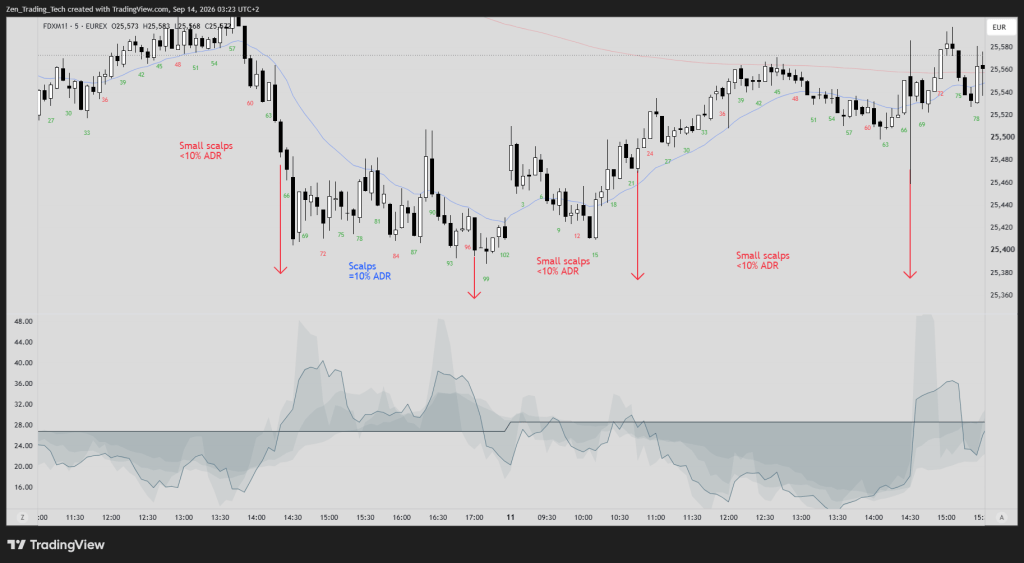
Use ATR or ABR (Average Bar Range) to check. I have a free Zen Bar Range indicator on TradingView that makes this easy. If today’s bars are 3x yesterday’s, you must reduce your number of contracts.
DAX size usually average bar range 30 points… what about on this day?
Looks small but… 3x
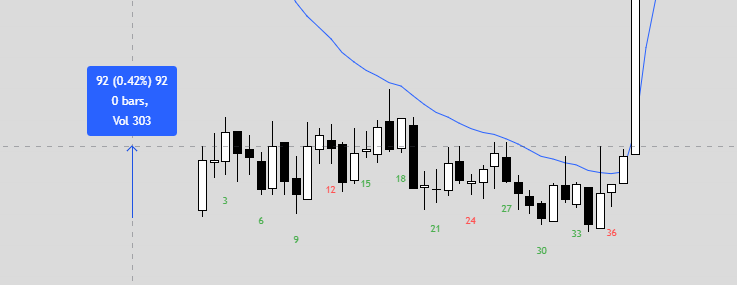
Here still double
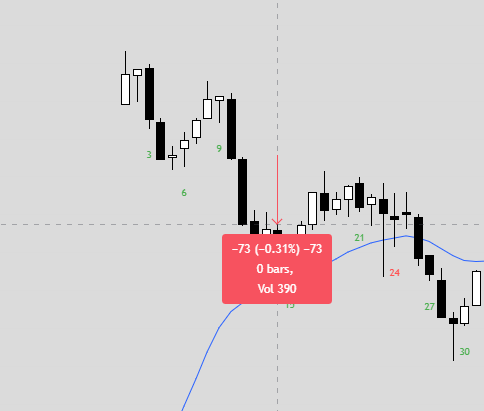
Use average bar range or average true range to help you judge before you take costly opening trades at the wrong size.
Here on my layout you can see I have it on every screen because I’ve been caught by it so many times in the past!
No Pre-Market Procedure
Do you even have a pre-market routine?
Before the session opens, you should already know the answers to a few key questions. What’s the market type — are we in a trend or a range on the higher time frame (HTF)? Where are the key levels? What trades am I allowed to take today?
No structure leads to no discipline, which leads to big losses. If you show up to trade the way most people show up to the gym — with no plan, just vibes — you’ll get the same results. Wasted effort.
If you have no procedure, just write one down and follow that. Then at the end of the session, rather than changing your trading, change the procedure. This builds confidence in your ability to consistently produce above-average results.
On the flip side when your trading performance dips, instead of changing your trading strategy, look at the process, look at your procedure. I bet you’ll find you did something differently before, during, or after the session. This has been my case for years.
Everyone wants to be consistently profitable but how many of us are willing to create the discipline to be consistent?
Trading the Open Without a Plan
The open is where most blow-ups happen. Wide bars, fakeouts, often 2–5 reversals in the first 90 mins. It’s the most volatile, most deceptive part of the session.
If you enter big early, you can lose fast. And then you’re chasing the rest of the day (see the “Big Losses Cause Big Losses” section above).
My approach: scale down on the open. Wait. Let the structure build. The first 15–30 minutes are for information gathering, not for heroics. The best trades of the day usually come after the open has settled.
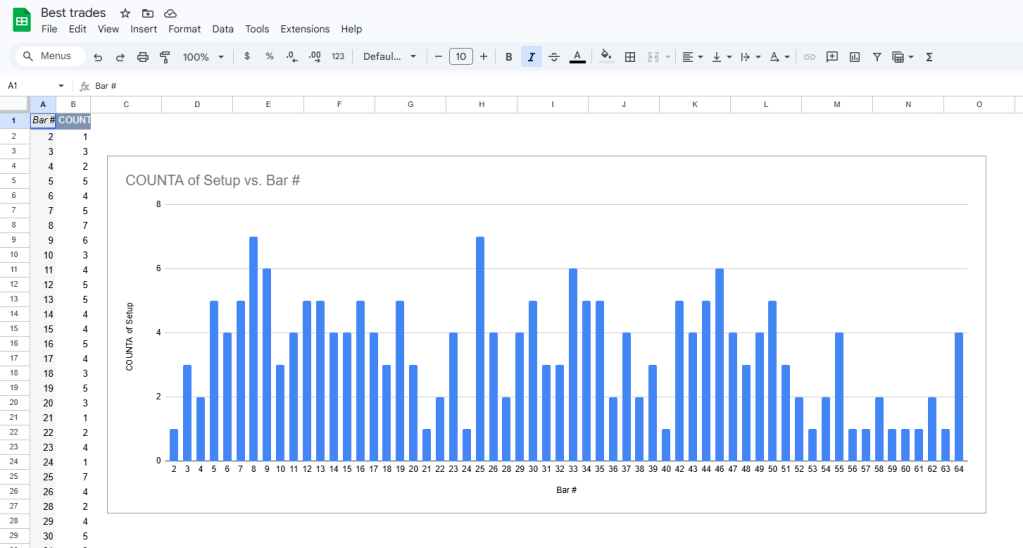
In my own research I catalogued months and months of trading days and painstakingly identified which bar number had the best trade of the day. I showed this slide in my presentation in Orlando. The number represents how often the best trade occurs on that bar. Look at how few are in the first couple of bars. Around bar 8 was the winner! So I’m pretty chill until then.
Turning Trades into Investments
The trade doesn’t work. Instead of exiting, you tell yourself “I’ll just hold. It’ll come back.”
Now you’re stuck. What started as a 5-minute scalp is now a swing trade you never planned for. You can’t let go because of FOMO, or regret, or the sunk cost of already being in the red.
If the trade fails, exit. A day trade is a day trade. A scalp is a scalp. Don’t let a losing trade change your time frame. That’s how small losses become account-ending disasters.
In order to stop scaling into losers, you have to look at the upside still left in the trade. The trade you thought was going to work has failed. Therefore the best that can happen to this trade is break-even.
Which is zero!
If the upside is zero but you still have the downside is that a good outcome? NO! That’s why you need to get out of it.
Oversizing Without Knowing It
What’s the right risk per trade? Most people say 2%. I’d say that’s way too much for a developing trader.
Start at 0.25% to 0.5% max. Yes, the gains feel tiny. That’s the point. You’re training, not trying to get rich by Friday. Focus on survival, not profits. Develop routine and confidence and procedure. It’s ok to push size – but do you have track record of wins at this smaller amount first?
If you can’t be profitable at 1 contract, adding more won’t fix it — it’ll just make the losses bigger and the emotions louder.
Signal vs. Setup — Don’t Confuse Them
“I felt it.” That’s not a setup.
I once asked my kung fu Sifu about intuition. I asked him whether I had it because sometimes I feel what’s about to happen before it happens. He said, “That’s great. How often does that happen?” I said, “Only occasionally.” He said, “Well that’s not intuition. When it’s always correct, that’s intuition. Until that point it sounds like you are following endless feelings that could be right or could be wrong. That’s not a good procedure for martial arts nor life.”
Setups are price action behaviours that repeat and you can codify enough to trade them. But you need a signal bar. The signal that setup is ready for you to trade. The signal bar also tells you where to enter.
Good traders can explain every detail of why they took a trade. If you can’t, you didn’t have a setup. You had a hunch. Maybe it’s a variation of a setup that you haven’t seen. Great, you can do more homework on it. You can be better prepared for next time.
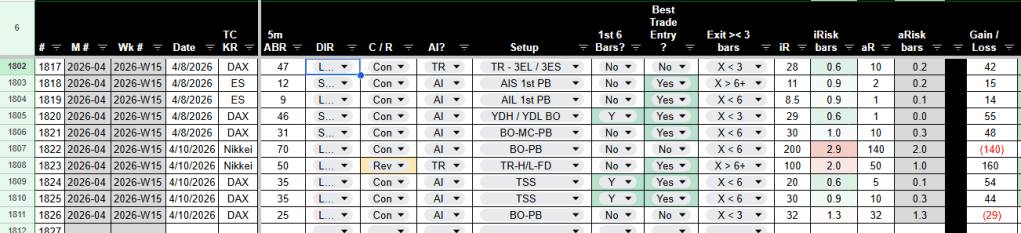
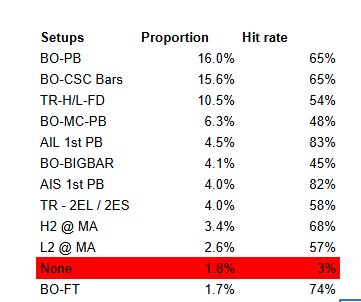
In my own trading I track set-ups for my trades. You can see in that set-up column there’s also a set-up called the “no set-up” set-up. That’s because sometimes I take trades that have no set-up and I’m trying to get rid of that in my trading.
Learn the difference. It’ll save you more money than any indicator ever will.
Look at my no-setup setup! Lol the worst hit rate by far…
Can’t Not Trade — The Addiction Loop
If you only feel alive when you’re in a trade, you’re in danger.
Trading addiction is real and it looks a lot like gambling addiction. The dopamine hit of being in a position, the rush of watching P&L move — it becomes the reason you trade, not the edge.
Find joy outside the screen — nature, sleep, training, breathing, time with people you care about. The ability to walk away from the charts and feel fine about it? That’s when patience can grow during trading I believe.
Homework: Find Your Pattern
Here’s an exercise. Do it this weekend.
Go through your last 20 trades. For each one, ask: does this trade match any of the sections above? Tag it. Be honest.
Then count. Which section showed up the most? That’s your number one priority. Not all of them — just that one. Work on it for a month.
If you don’t have a trade journal — start one. Even a spreadsheet with three columns: date, setup, and result.
Come back to this post next month and do the exercise again. See if the numbers changed. That’s how you know you’re improving — not from your P&L, but from the frequency of your mistakes going down.
Conclusion
Nobody blows up their account because of one bad trade. They blow it up because of a series of small habits that join together. But we can change our habits the same way we train our bodies. Day by day, set by set, rep by rep.
Every section in this post comes back to the same thing: not having a process, or not following the one you have.
Pick the one from this post that hits closest to home. Name it. Work on just that one thing for a month. You’ll be surprised what changes.
Happy trading!
Tim
Zen Trading Tech





Leave a comment