Let me make it simple:
- No setup = no trade idea.
- No signal = no entry.
In my reviews with hundreds of traders, there’s one mistake I see more than almost any other.
It’s subtle, but it sabotages your entries, messes with your stop placement, and creates hesitation in the moment.
👉 The mistake? Confusing a trade setup with a trade signal.
If you separate these two clearly, you’ll immediately trade with more confidence and precision.
✅ The Framework I Use: Setup → Signal → Trigger → Exit → Failure
Here’s the process I use to clarify any trade I’m considering:
- Setup – The market condition that creates the opportunity (e.g., pullback in a bull trend, wedge top in a range).
- Signal – The specific bar that justifies entering (e.g., a bear bar at the high of a range, a bull bar in a pullback).
- Trigger – The exact price that activates your entry (e.g., 1 tick below a signal bar).
- Exit – Where you plan to exit if the trade works.
- Failure – What tells you the trade idea is wrong and it’s time to get out.
Traders get emotional and reactive when they skip one of these. I see it all the time: entries without clear signals, or trades held too long because there was never a failure plan.
You can easily mark it up in a Google Sheet as you go – example below.
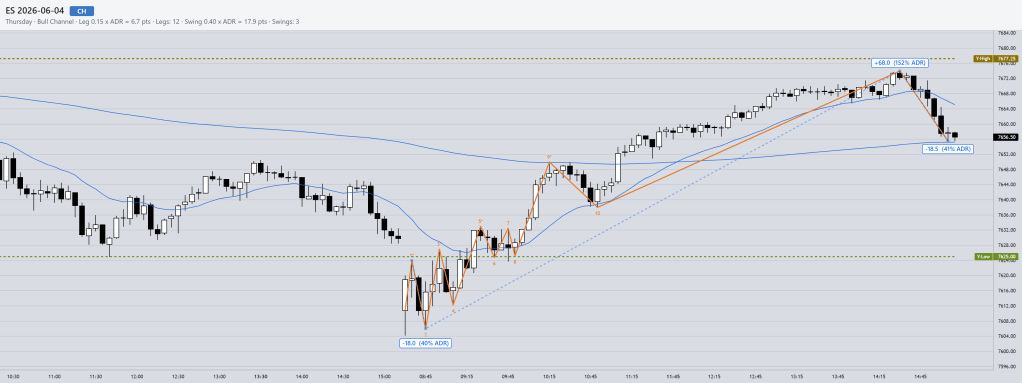
📉 Example: Micro Channel Long

I took a trade recently where:
- The setup was a bull micro channel after a gap down.
- The signal was the third consecutive bull bar.
- The trigger was one tick above that signal bar.
- My stop was below the micro channel low.
- The failure condition was a second close below the signal bar.
Because I had this all mapped out, the trade was easy to manage. No guessing. No second-guessing.
💥 Marking Up Your Trades

Most traders I talk to don’t mark up their trades.
That’s like trying to improve a physical skill without using video.
Yet I think its the best way to improve my trading – I do it everyday.
Here’s my method:
- ✅ Green box = buy
- ❌ Red box = sell
- ➖ Dotted line = stop
- 🟦 Blue box = exit
I also write how long I traded that day. It gives me context—what I traded, what I skipped, and what my mindset was during the session.
🧠 Why It Matters
The clearer your structure, the easier it is to:
- Know what you’re doing.
- Review what went wrong.
- Refine how you trade.
Price action doesn’t reward “vibe-based” decisions. It rewards structure and execution.
So next time you’re about to enter, ask:
- Do I have a setup?
- Do I have a signal bar?
- Do I know my failure point?
If the answer to any of those is no—don’t enter. Discipline is an edge.
🎯 Challenge for You This Week
Take 3–5 of your trades and break them down using this formula:
- Setup
- Signal
- Trigger
- Exit
- Failure
If you want feedback, tag me in the comments of the video or post.
👉 Watch the full breakdown here:
📺 YouTube: Setup vs Signal — The #1 Mistake Traders Make
– Tim Fairweather



Leave a Reply