Summary (TL;DR)
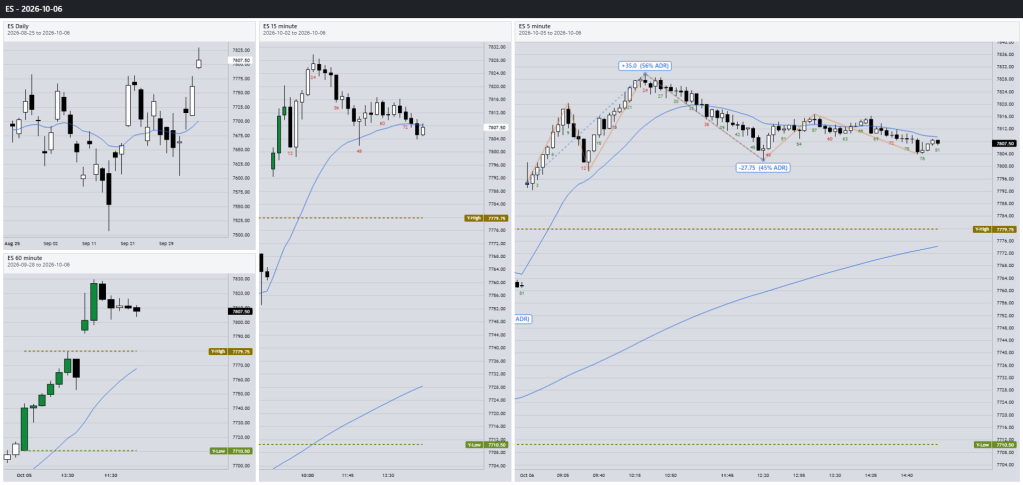
- There’s a saying: the bigger the gap, the more chance of a trading range day. I have been trading on it. But I will show how I have changed this for myself.
- I uncovered a hidden bias in my trading. When I saw a big gap, I thought “trading range day”, so I traded for scalps. On a big gap the better plan is to swing both ways.
- Trading range days fall on big gaps: about 65% of days on small gaps, 55% to 61% on the biggest. Trend days rise a little.
- What a big gap does bring is a bigger day. The range goes from about 98% of ADR on small gaps to 144% of ADR on gaps of 100% or more.
- The bigger day is made of more legs and more swings, not bigger ones. The average leg stays near 32% of ADR and the average swing near 74% in every gap size.
- Gap direction matters more than gap size. Gap downs make bigger days with more legs than gap ups of the same size.
- A very big gap up does not raise the chance of a bull Small Pullback Trend day. But the gap direction nearly decides which way a Small Pullback Trend day goes.
The saying
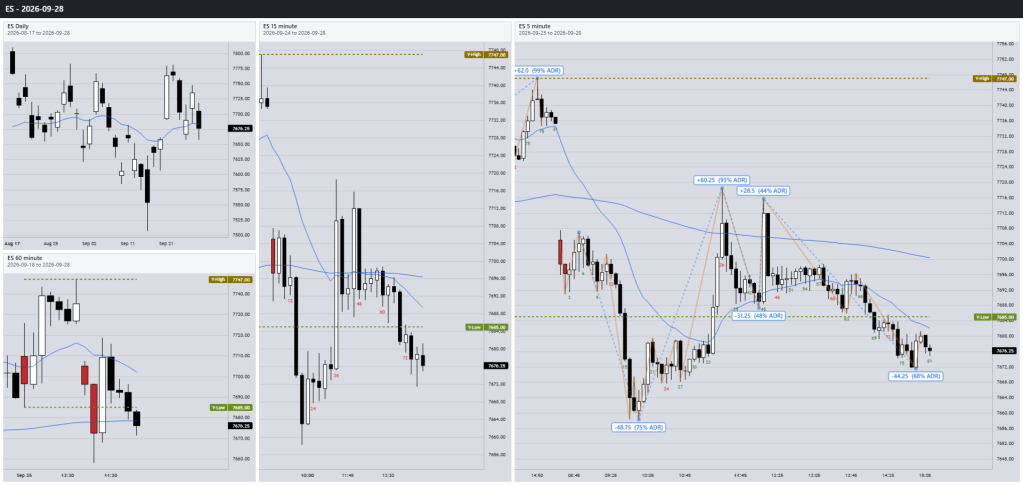
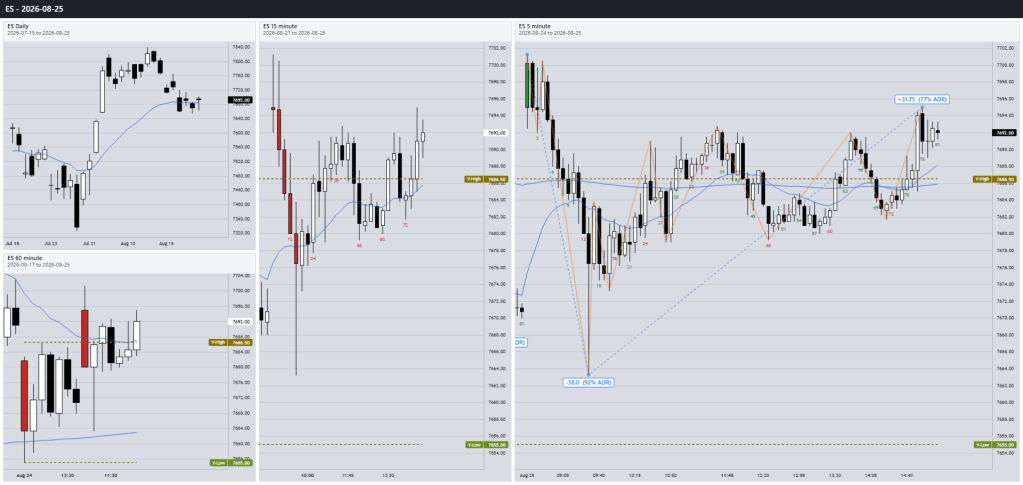
In Legs, Swings and Day Type I linked legs to swings, and swings to my day types.
Bars -> Legs -> Swings -> Days.
This post adds one thing that happens before the first bar: the opening gap.
Here’s the question. You hear it a lot: the bigger the gap, the more chance of a trading range day. I have been trading on that. If it’s true it changes how I trade the open. If it’s wrong I’ve been leaning the wrong way.
So I tested it. Then each answer raised the next question, so this post follows that path.
Same rulers as last time:
- Gap: today’s open minus yesterday’s close. Day session only (RTH – regular trading hours, 08:30 to 15:15 Chicago).
- ADR: my 8-day average of the daily range, up to yesterday. Every size in this post is a % of ADR. No points.
- Leg: at least 15% of ADR. Swing: at least 40% of ADR.
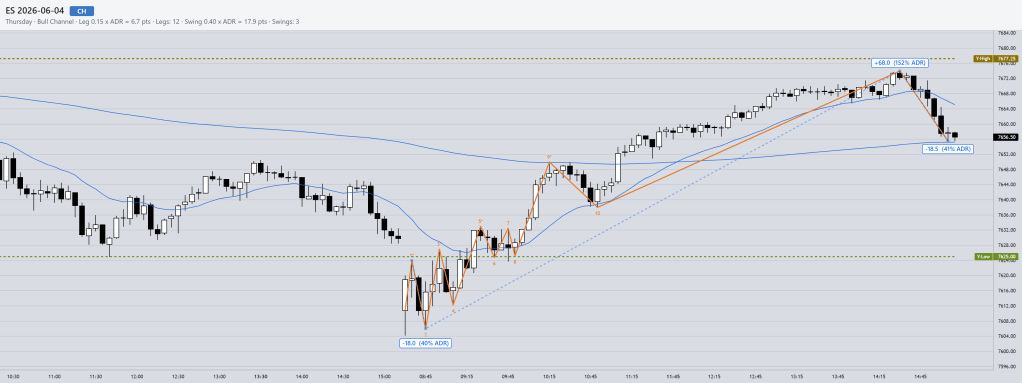
- Day type: my own hand labels from What is a Trend Day? Small Pullback Trend, Channel, Broad Channel and Trading Range.
ES, December 2015 to October 2026. 2,711 days with a gap: 1,505 gap ups and 1,206 gap downs. (14 days opened exactly on yesterday’s close. They’re left out.) I sorted the gaps into bands 10% of ADR wide, from 0 to 10% up to 100% and over.
Does a bigger gap mean more trading range days?
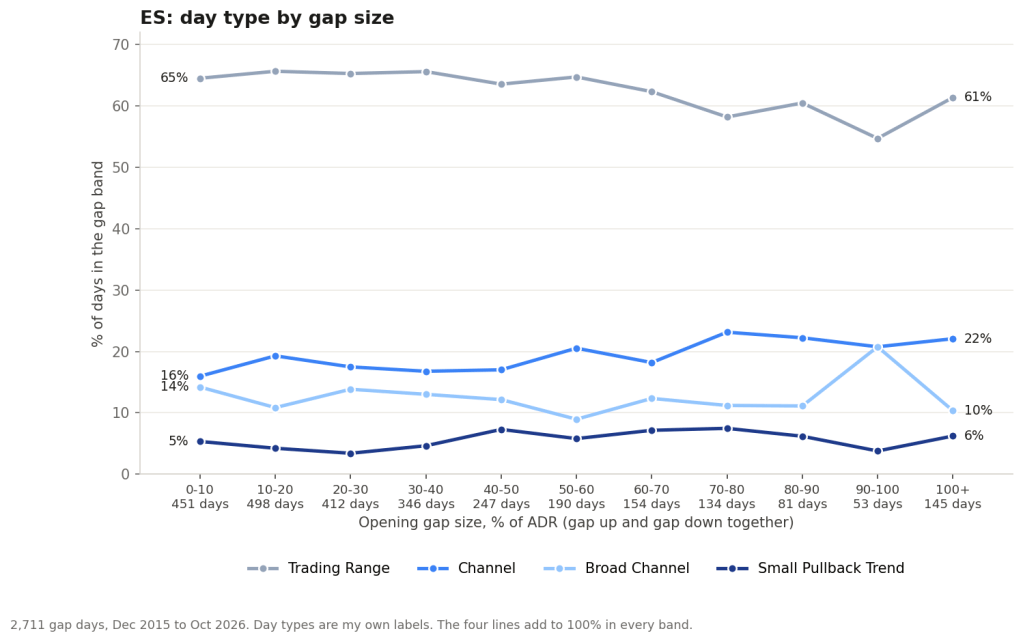
No. Trading range days go down a little, not up.
- Gaps of 0 to 10% of ADR: 64.5% trading range days.
- Gaps of 70% of ADR or more: 54.7% to 61.4%.
And trend days (Small Pullback Trend plus Channel) go up a little. 20.9% to 24.3% of days on gaps under 50% of ADR. 24.5% to 30.6% on gaps of 50% or more.
Trading range is still the most common day in every band. Everything is 40-60, as Al Brooks says. But the saying has the direction wrong. A bigger gap leans slightly towards a trend day, not a trading range day.
So the saying doesn’t hold up against my own day type labels.
Which raised the next question. If gap size doesn’t decide the day type, what does it change?
A bigger gap, a bigger day
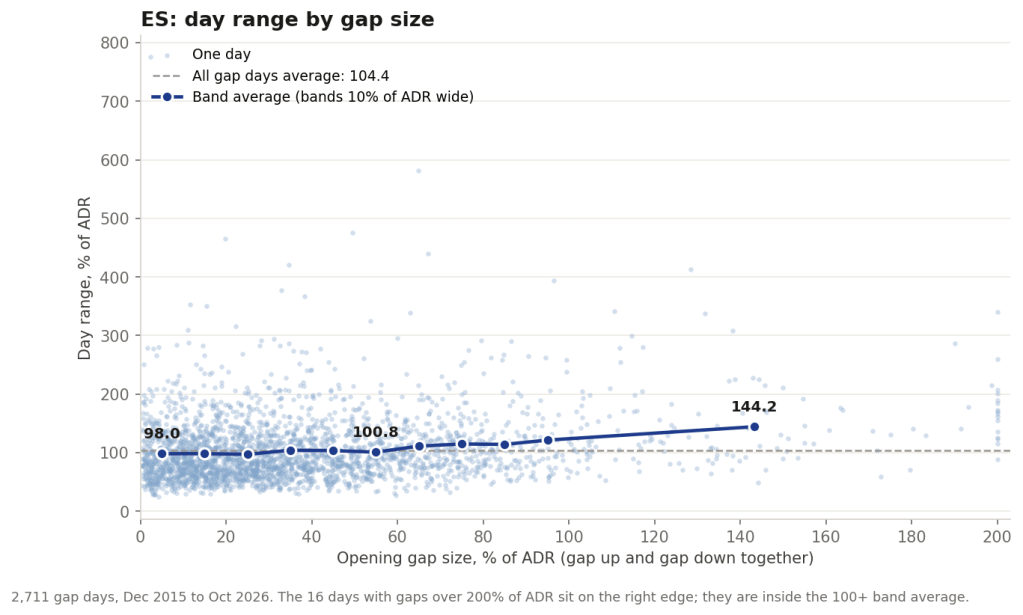
Each dot is one day. The line is the band average.
The range sits at 97% to 104% of ADR on gaps under 60% of ADR. Then it climbs: 111% to 121% on gaps of 60% to 100%, and 144% on gaps of 100% or more.
Now the same idea as last post. Is the bigger day made of more moves, or bigger moves?
Yes – I used to think that a big gap led to a trading range day. The relationship I was seeing was that there are actually many more legs. Because the chance of a trend day doesn’t change much, there are legs in both directions, hence two-sided trading.
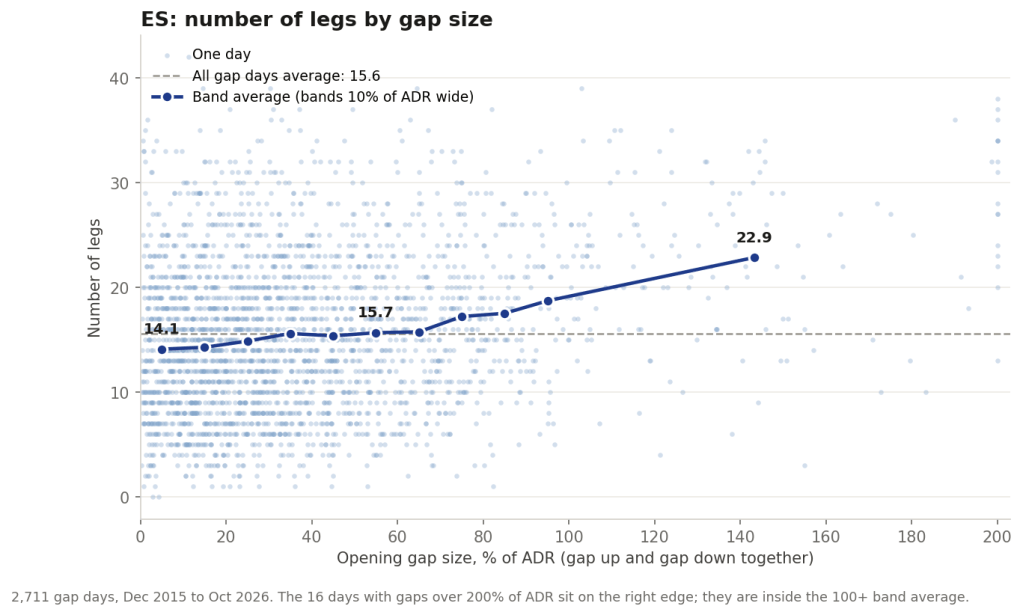
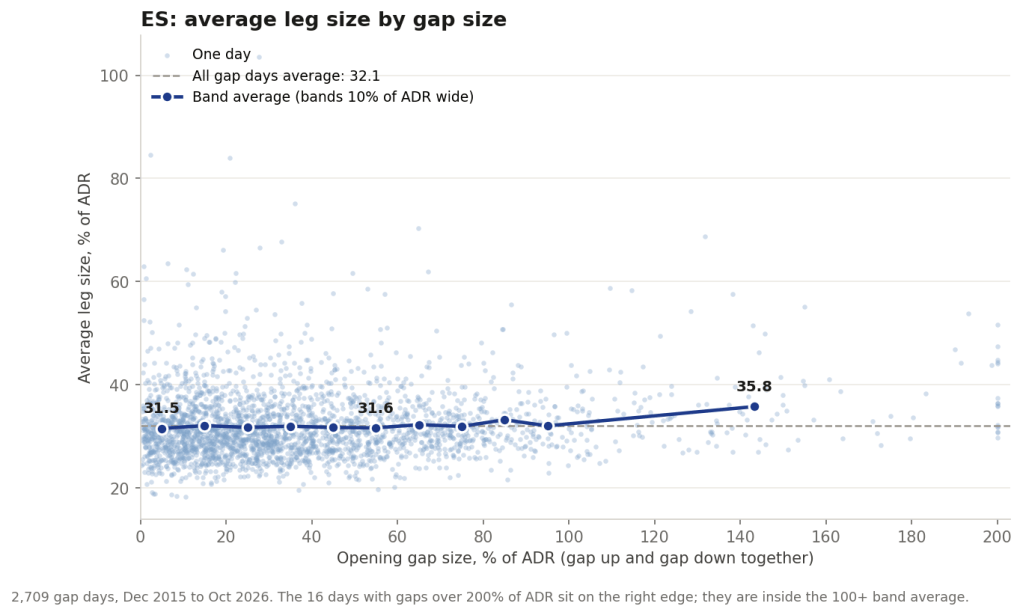
Legs go from 14.1 a day on the smallest gaps to 22.9 a day on the biggest. But the average leg stays at 32% to 33% of ADR all the way to 100%. Only the 100% and over band moves, to 36%.
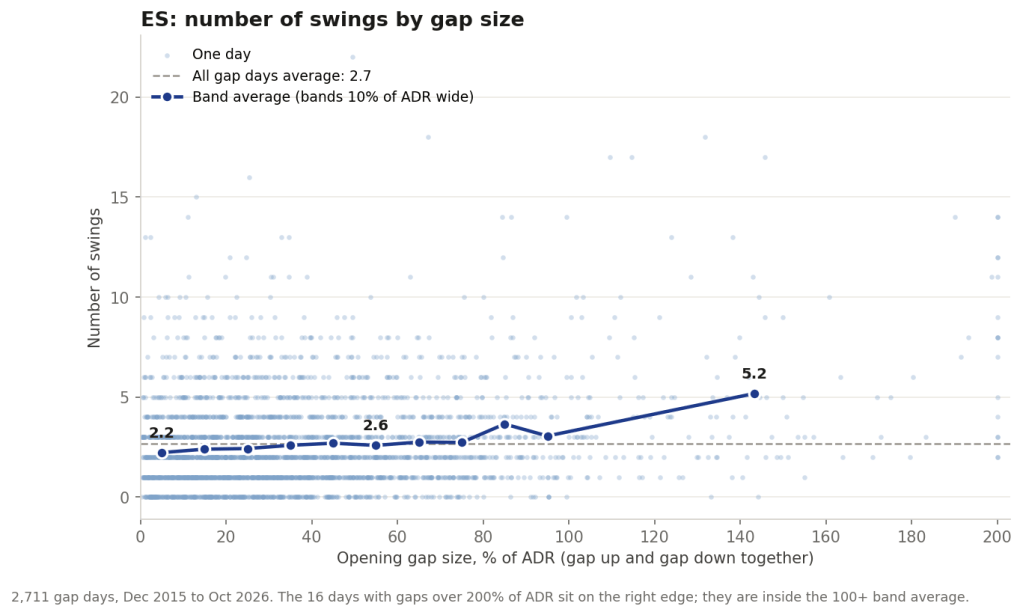
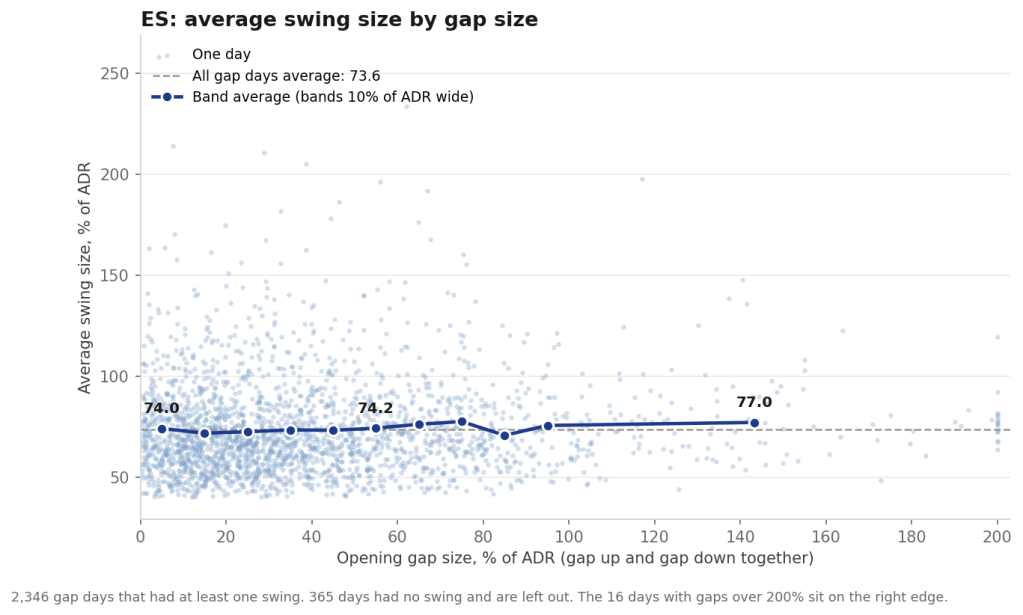
Swings go the same way. 2.2 a day on the smallest gaps, 5.2 a day on the biggest. The average swing is 71% to 78% of ADR in every band, with no pattern.
Simply: a big gap makes the day bigger by adding more legs and swings of a normal size. It doesn’t make each move bigger.
And almost all of the change sits in gaps over 60% of ADR. That’s only 21% of gap days. On the other four days in five, gap size barely moves anything.
Gap up or gap down?
Everything so far has gap ups and gap downs together. So I split them. Each pair of charts has the same scale, so you can compare them directly.
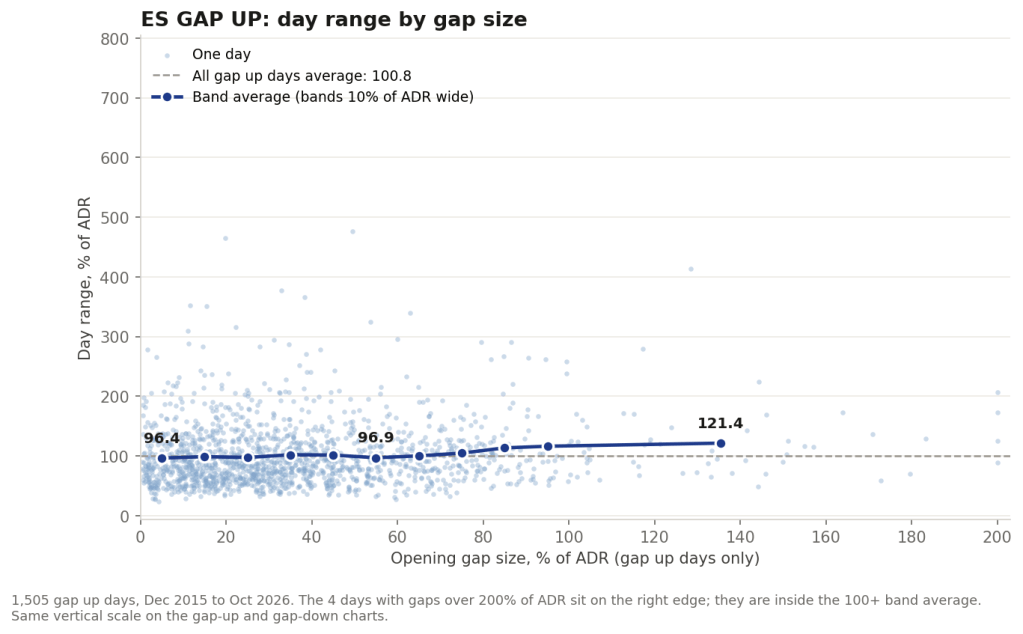
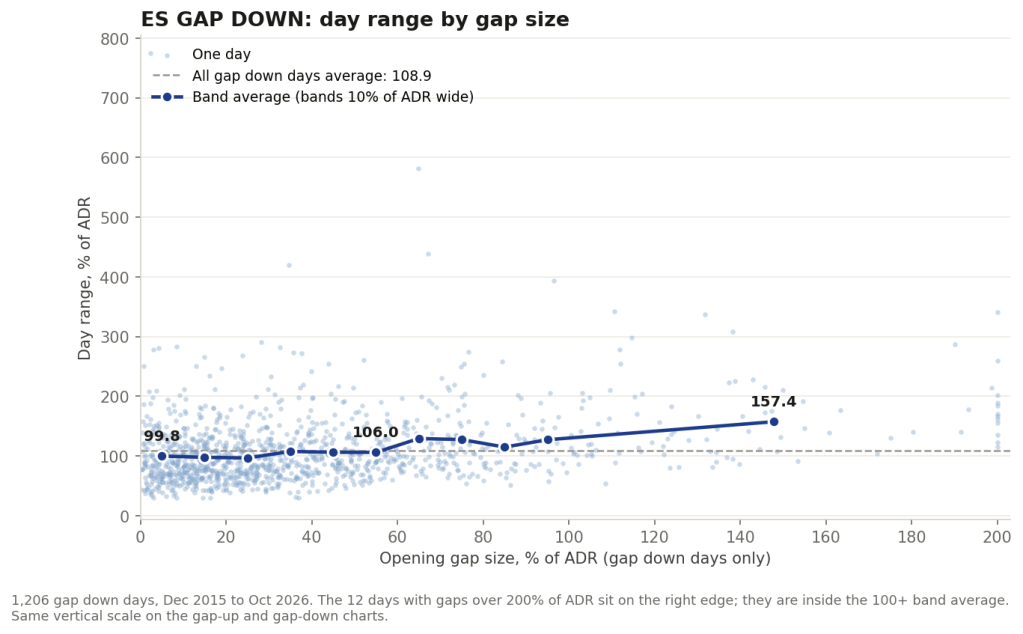
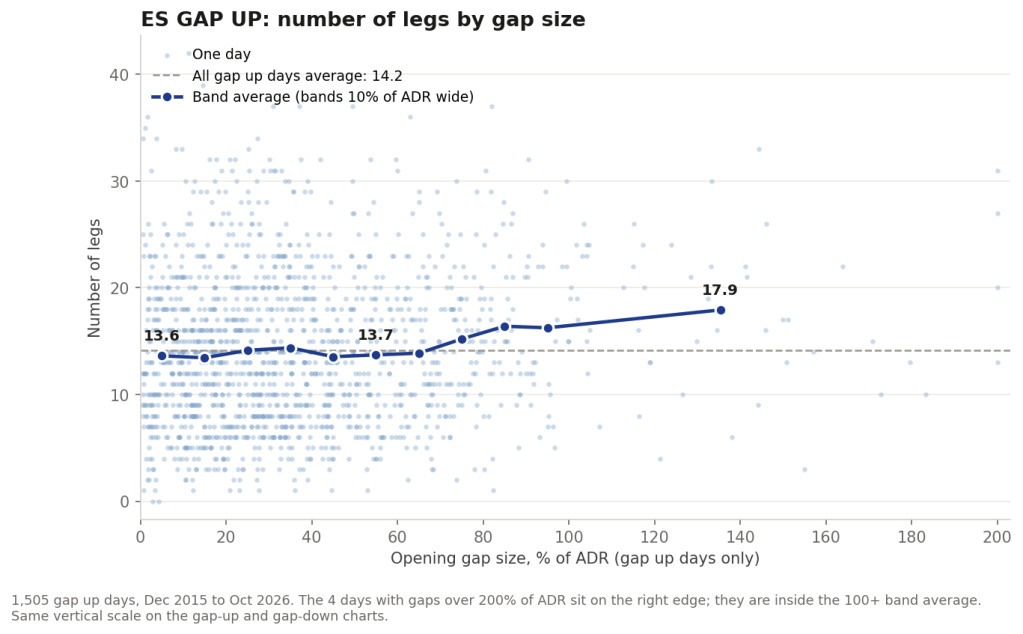
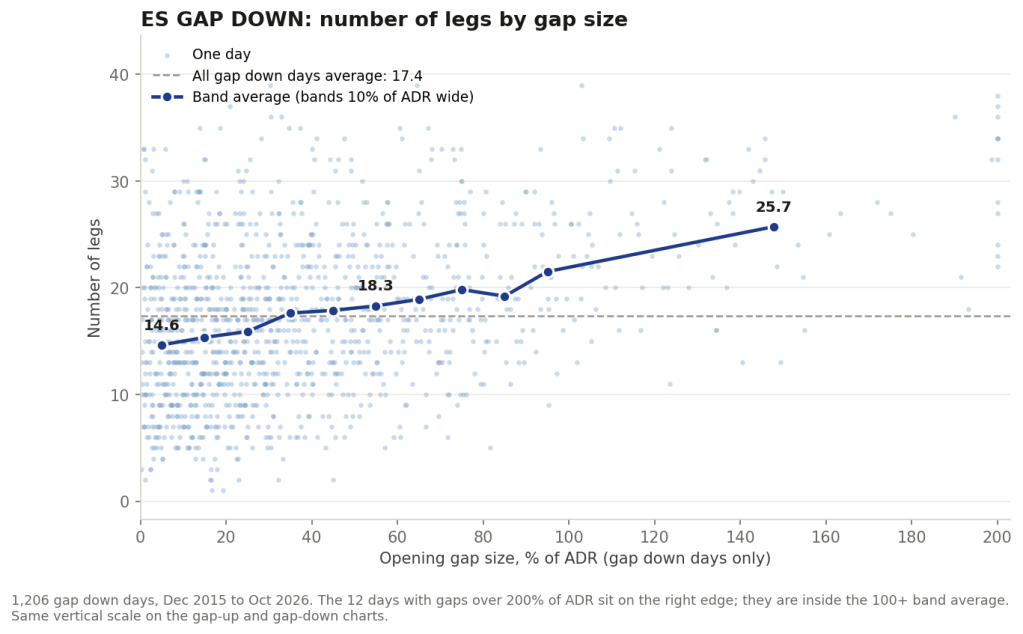
They’re not the same.
- Gap up stays flat until 80% of ADR. Range 96% to 105% of ADR, about 14 legs, about 2.3 swings. Only gaps of 80% or more lift the range, to 114% to 121%.
- Gap down starts climbing early. Legs rise from gaps of about 30% of ADR. The range rises from about 60%, up to 157% of ADR.
- The biggest gap downs are the biggest days. Gaps of 100% or more: a gap down averages 157% of ADR, 25.7 legs and 6.2 swings. A gap up of the same size averages 121%, 17.9 legs and 3.4 swings.
- Leg and swing size still don’t change on either side. 31% to 34% of ADR for a leg (37% on the biggest gap downs). 70% to 79% for a swing.
Here’s the bit. On gaps of 30% to 60% of ADR, a gap down day has about 4 more legs than a gap up day of the same size. But its range is less than 10% of ADR bigger.
Now think about what that means. More legs inside nearly the same range. That’s more back-and-forth. More reversals for the same amount of ground.
Bull or bear?
If direction matters that much, does it show up in the bull and bear day types? And one question I wanted answered: does a very big gap up raise the chance of a bull Small Pullback Trend day?
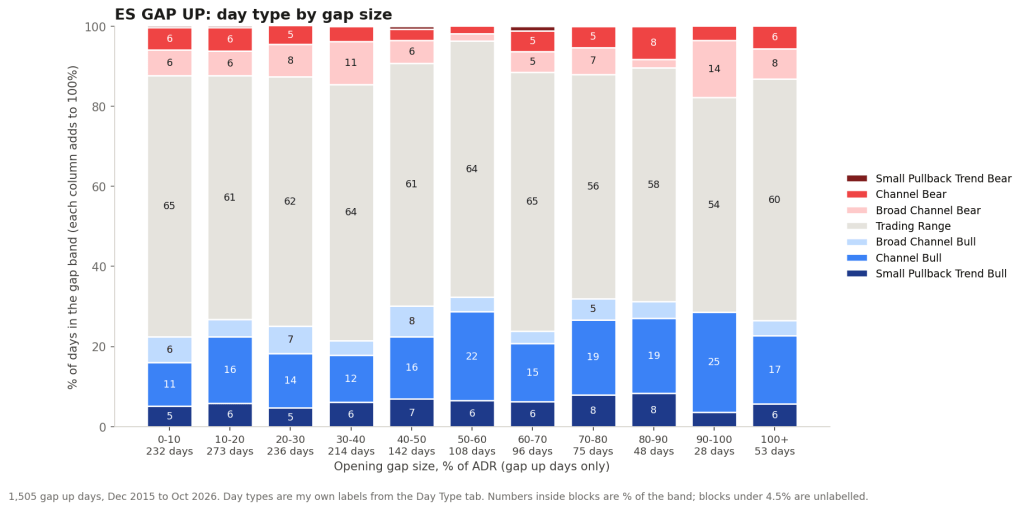
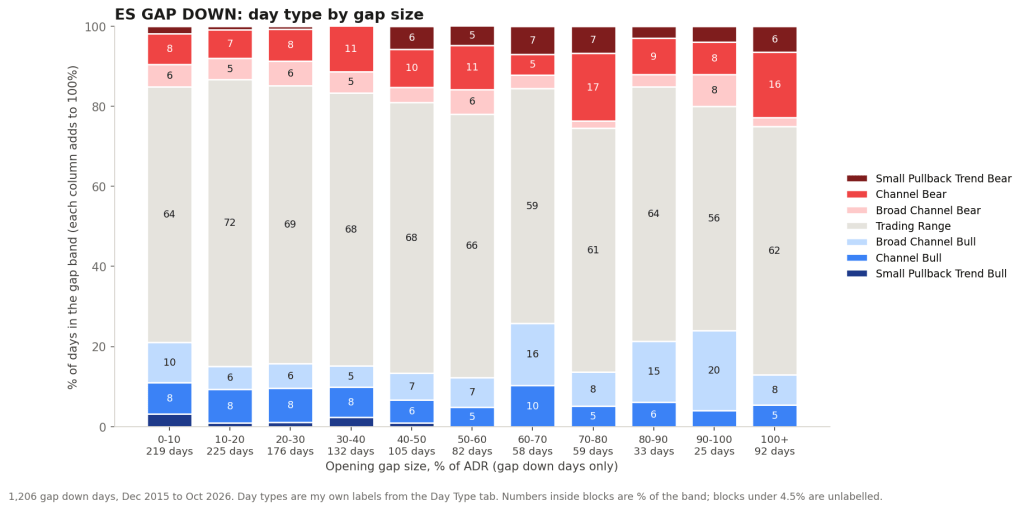
Caveat going in: Small Pullback Trend days are rare. Many of these blocks hold only a few days.
No. On all gap up days the chance of a bull Small Pullback Trend day is 5.9%, about 1 day in 17. On gaps of 100% or more it’s 5.7% (3 days out of 53). On gaps of 90% to 100% it’s 3.6% (1 day out of 28). The 70% to 90% bands show about 8%, but that’s 6 days and 4 days. One or two days either way would change it.
But the direction of the gap nearly decides which way a Small Pullback Trend day goes:
- 89 of the 93 Small Pullback Trend days on a gap up were bull.
- 33 of the 48 on a gap down were bear.
- A gap down of 50% of ADR or more never gave a bull Small Pullback Trend day. 0 out of 349 days.
Channel days follow the gap more as it grows. Channel Bull is 15.0% of all gap up days, but 19% to 25% on gaps of 70% to 100%. Channel Bear is 9.5% of all gap down days, but about 16% to 17% on gaps of 70% to 80% and 100% or more.
One odd one. Big gap downs also bring more Broad Channel Bull days – 15% to 20% on some of the big bands, against 8.0% on all gap downs. That’s only 5 to 9 days a band, so I’m not reading much into it.
And trading range is still the most common day either way: 62.1% of gap ups, 66.3% of gap downs.
What I’m taking into the open
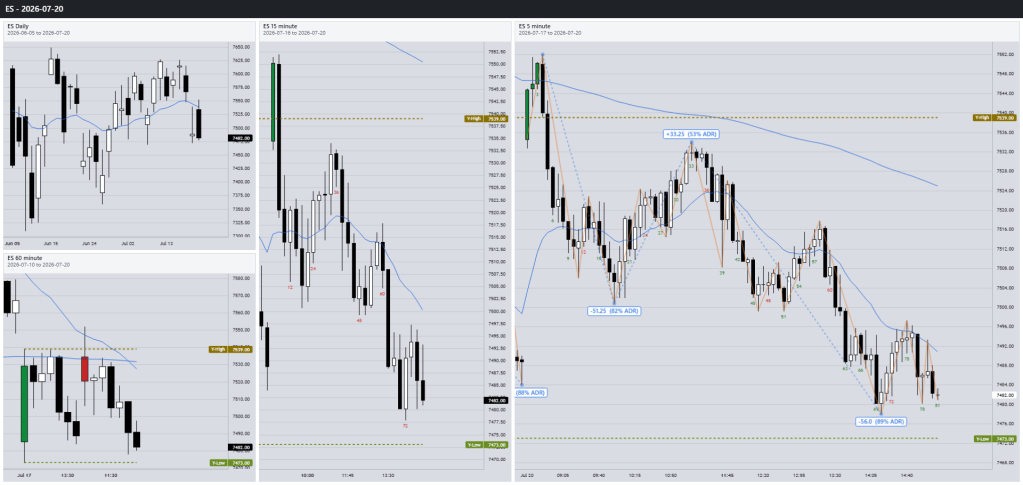
- I’m not expecting a trading range day just because the gap is big.
- On a big gap I’m expecting a bigger day, with more swings of a normal size in both directions.
- On a gap down of 30% of ADR or more I’m expecting more back-and-forth.
- On a gap up, if it turns into a Small Pullback Trend day, it’s almost always bull.
Does it tell me what today will be? No. Trading range is still the most likely day on every gap. After I take profit on a long swing, I’ve been missing the short swing that follows. The same holds the other way on bear moves.
Caveats
- ADR is an 8-day average, so it’s slow to catch a sudden jump in daily range. That can make big-gap days look bigger still.
- Everything is measured at the close. It describes the days. It doesn’t tell you what today is while you’re in it.
- Day types are my own hand labels, so my eyes are in the data.
- The biggest bands are small. Read the day count before the percent.
- ES only in this post.
Conclusion
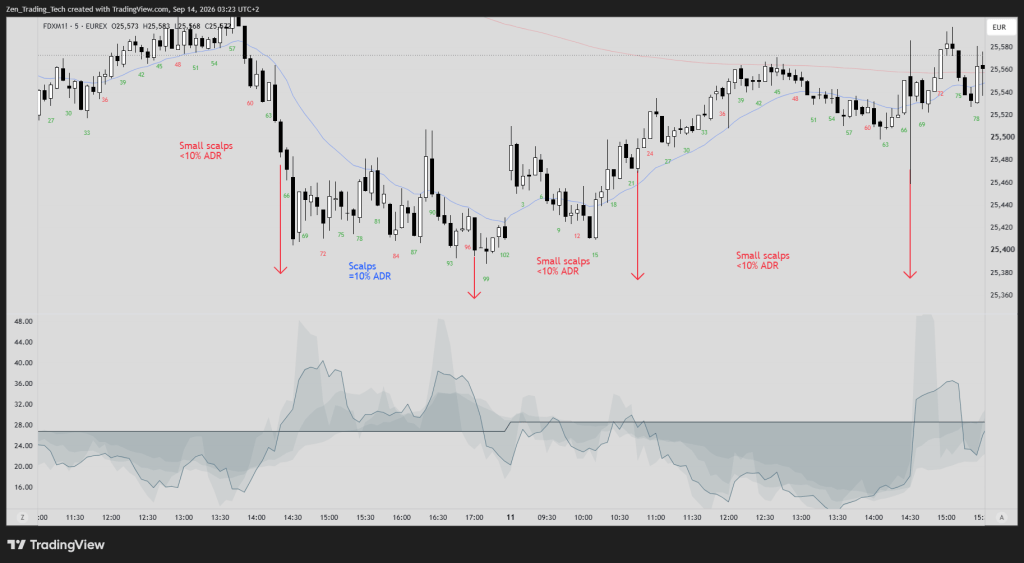
I uncovered a hidden bias in my trading. When I saw a big gap, I thought “trading range day”. In a trading range the rule is “buy low, sell high, scalp” (BLSHS). So I traded for scalps.
The data says otherwise. A big gap brings slightly fewer trading range days, not more. It brings a bigger day, made of more legs and swings of a normal size. And the direction of the gap matters more than its size.
So on a big gap open, the rule should be “buy low, sell high, swing – both ways”.
Happy trading!
Tim
Zen Trading Tech



Leave a Reply