Someone said it again this week:
“Everyone knows Thursdays sell off into the weekend on the DAX….
I’ve heard some version of that line for years — on Fridays too, on other markets, always stated as fact, never with a number attached.
So I ran it. FDAX daily data, 2008 to now, every close compared to the close before it.
Verdict up front: it’s bollocks.
But the way it’s bollocks is the actual lesson here — this is a template for testing any one-liner you hear in a trading room. Not just this one.
How I tested it
Three checks. Every one of these you can run on any claim you hear.
- Win rate. Of all Thursdays, what percent closed higher than the day before? That’s the direct test of “sells off.”
- Median, not average. One or two huge days can drag an average around and hide what a normal day actually did. The median tells you what the typical day did.
- Split-half. Cut the history in two. Check the first half against the second half separately. A real pattern holds its shape in both. Noise flips.
946 Thursdays in the sample, out of 4,693 trading days total, 2008 to 2026.
Check one: win rate
Thursday closes higher than the prior close 53.2% of Thursdays. That’s an absolute number, not a change from anything — just over half.
Monday: 52.7%. Wednesday: 54.4%. Friday, the day that’s supposed to be the victim of the Thursday selling: 52.4%. Thursday isn’t the weak day. It isn’t even close to being the weak day.
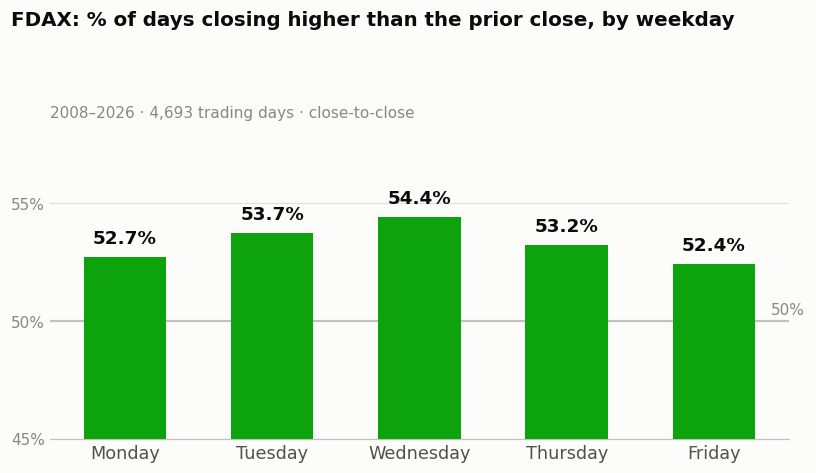
If the claim were true, this is the first place it should show up. It doesn’t.
Check two: the mean vs. median trap
Here’s where it gets interesting, and where most people testing a claim like this would stop too early and get the wrong answer.
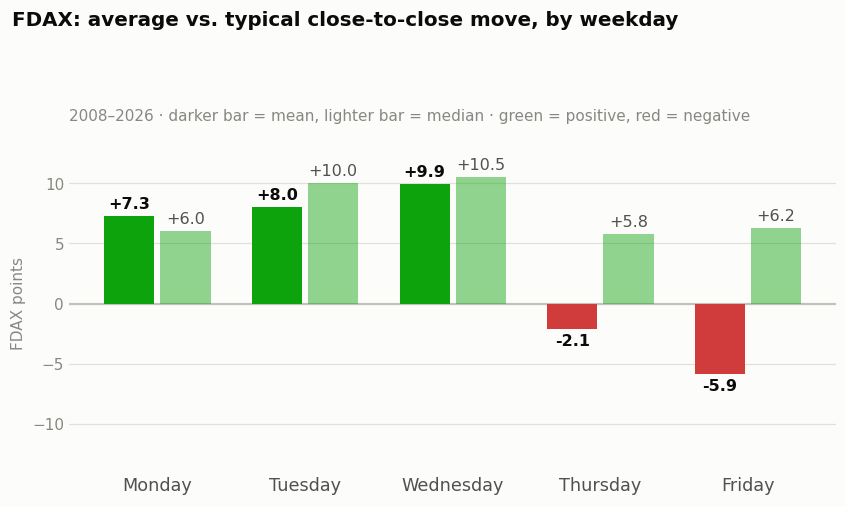
Thursday’s average close-to-close move is -2.1 FDAX points. Negative. Looks like the claim just won.
Thursday’s median close-to-close move is +5.75 points. Positive. The typical Thursday goes up.
Simply: the average and the median disagree on the direction. When that happens, a small number of extreme days are doing the work, and the “typical day” story the average tells you is false.
Five days doing all the damage
The five worst Thursdays in the sample:
- 2020-03-12: -1,161 points. COVID crash.
- 2025-04-03: -677 points. The tariff selloff.
- 2026-03-19: -674 points.
- 2022-02-24: -550 points. Russia invaded Ukraine.
- 2026-01-29: -547 points.
Take those five days out of 946 and the Thursday average flips from -2.1 points to +1.7 points.
Five days out of 946 — about half a percent of the sample — turn the whole story around.
None of those five days is a Thursday thing. Crashes land on whatever day they land on. A handful of them happened to land on a Thursday over eighteen years, and that’s enough to paint an average red.
Check three: split-half
Cut the eighteen years in half. In the first half, Thursday’s average close-to-close move was +2.0 points. Positive. In the second half, -6.2 points. Negative.
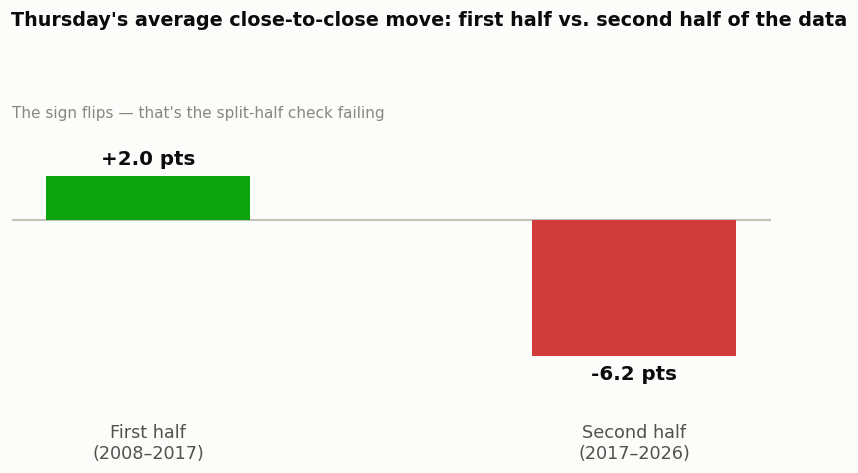
The sign flips. A real, repeating pattern doesn’t do that — it holds its direction in both halves, even if the size changes. This one doesn’t hold. That’s the split-half check failing, and it’s the same test I use before I’ll publish any finding as real.
What’s actually true about Thursday
Thursday does stand out on FDAX. Not on direction — on range.
It’s the widest-ranging day of the week, and Monday is the narrowest, and that part does pass the split-half test: Monday ranks quietest and Thursday ranks widest in every half of the data I cut, both on FDAX and on ES.
Chart showing (today’s high − today’s low) ÷ today’s close, ×100.
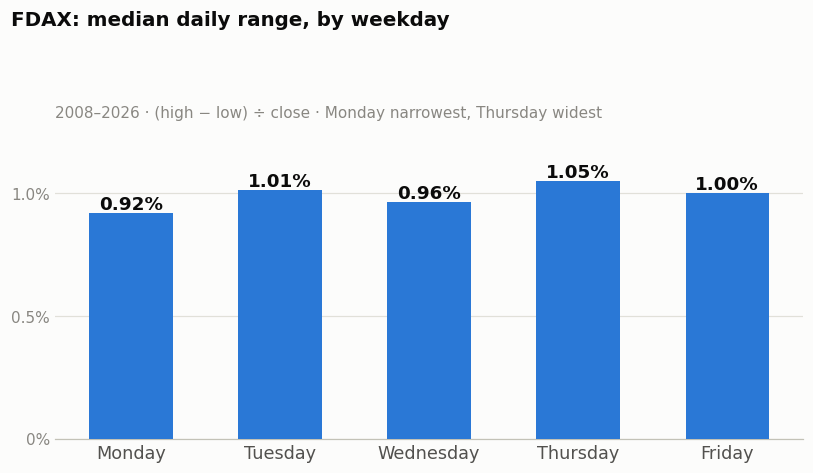
“Widest range” and “sells off” are not the same claim. A wide-range day can close up just as easily as it closes down — and on Thursday, slightly more often than not. I think that’s where this one-liner comes from: someone noticed Thursday moves more, and the story that got attached to it was direction instead of size.
The actual point of this post
Not the DAX, not Thursday. The point is that this claim took ten minutes to test properly, and testing it properly meant not stopping at the first number.
You’ve heard your own version of this. “Never trade the first five minutes.” “Mondays are choppy.” “Don’t trade Fridays after lunch.” Some of them might be real. Most of the ones I’ve tested aren’t — not because the person saying them is lying, but because a handful of memorable days built the story and nobody checked in detail.
In the age of AI – we can check this very easily.
Pick one of the one-liners you trade around without ever having checked. Pull the data. Run win rate, median, and split-half on it. Data beats opinion, and this is what “do your own research” actually looks like in practice.
Happy trading!
Tim
Zen Trading Tech



Leave a Reply