Summary (TL;DR)
- The question: if the first swing of the day is down, what does that do to the day type? Does it kill the bull trend day? Does it make a bear trend day more likely? Is a trading range day just as likely?
- First swing down: a bull trend day falls from 15.4% of all days to 4.2%. A bear trend day rises from 8.1% to 14.7%.
- First swing up: a bull trend day rises to 27.2%. A bear trend day falls to 2.3%.
- The trading range day barely moves. 66.8% after a down first swing, 59.7% after an up one, against 64.1% of all days. It’s still the most likely day either way.
- Simply: the first swing tells you which trend day you probably won’t get. It doesn’t tell you whether you’ll get one.
- You know it early. Half of all first swings are in by bar 9 (09:10 Chicago).
- First swing longer than 2 hours. If the first swing started in the first hour and has had no 40% of ADR pullback by bar 24, a trend day from the open the other way is gone. 13 days out of 1,251 trended the other way, and every one was an opening reversal first.
- 90 days never made a swing. 81 of them (90%) were trading range days.
- Add the gap. When the gap and the first swing go the same way, 30.3% of days are trend days that way. When they go opposite ways, 68.5% of days are trading range days.
- The first swing tells you more than the gap. But the gap still adds to it. Together they tell you most.
The question
In Legs, Swings and Day Type I linked legs to swings, and swings to my day types. Then in Does a Big Gap Mean a Trading Range Day? I looked at the one thing that happens before the first bar: the opening gap.
This post moves one step into the day. The first swing.
Here’s the question. If the first swing of the day goes down, does that limit the chance of a bull trend day? Does it raise the chance of a bear trend day? Or is everything still on the table, and a trading range day just as likely as before?
The day type is a close-of-day label. You only know it once the day is done. But the first swing is something you can see while the day is still running. So if the first swing moves the odds, that’s a read you can use in the session.
Same rulers as the last two posts:
- ADR: my 8-day average of the daily range, up to yesterday. Every size in this post is a % of ADR. No points.
- Leg: at least 15% of ADR. Swing: at least 40% of ADR, built from legs.
- First swing: the first move of 40% of ADR in the session, up or down. It doesn’t have to start at the open. If price dips a little first, then runs up 40% of ADR from that low, that’s an up first swing.
- Day type: my own hand labels from What is a Trend Day? A trend day here is Small Pullback Trend or Channel, split bull and bear. Broad Channel isn’t a trend day, so it gets its own line. Everything else is Trading Range.
ADR, leg count, swings and day type are my own measures and names. None of them is an industry standard.
ES, day session only (RTH – regular trading hours, 08:30 to 15:15 Chicago). December 2015 to October 2026. 2,725 days with one of my day type labels. 1,303 had a down first swing, 1,332 an up first swing, and 90 never made a swing at all.
First swing down
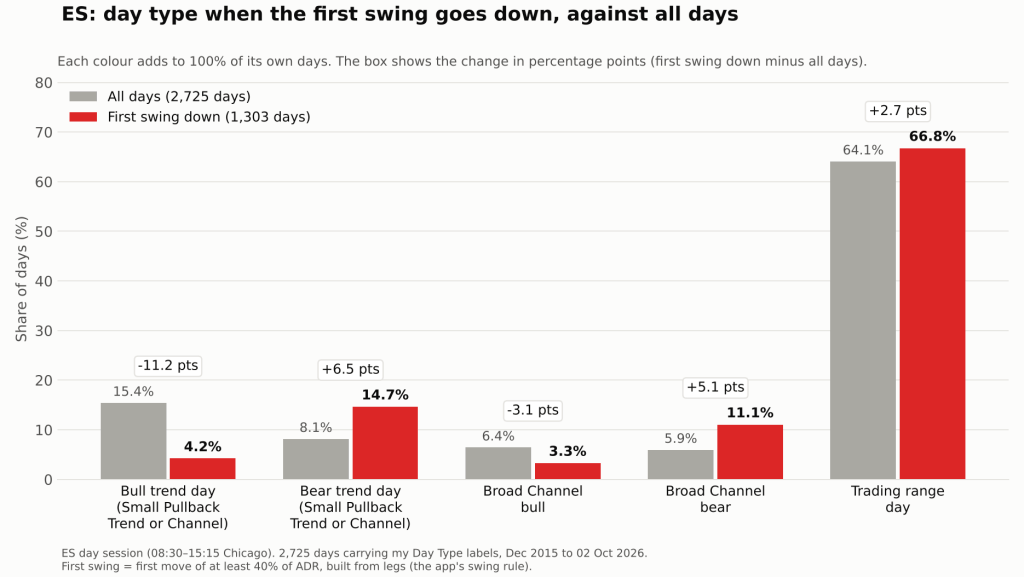
Grey is all days. Red is days where the first swing went down. The box over each pair is the change.
- Bull trend day: 15.4% of all days. 4.2% after a down first swing. That’s about a quarter of the normal chance.
- Bear trend day: 8.1% of all days. 14.7% after a down first swing. Nearly double.
- Trading range day: 64.1% of all days. 66.8% after a down first swing. Barely moves.
So yes, a down first swing mostly takes the bull trend day off the table. And yes, it raises the bear trend day. But it doesn’t make a bear trend day likely. 14.7% is still about 1 day in 7. Two days in three are still trading range days.
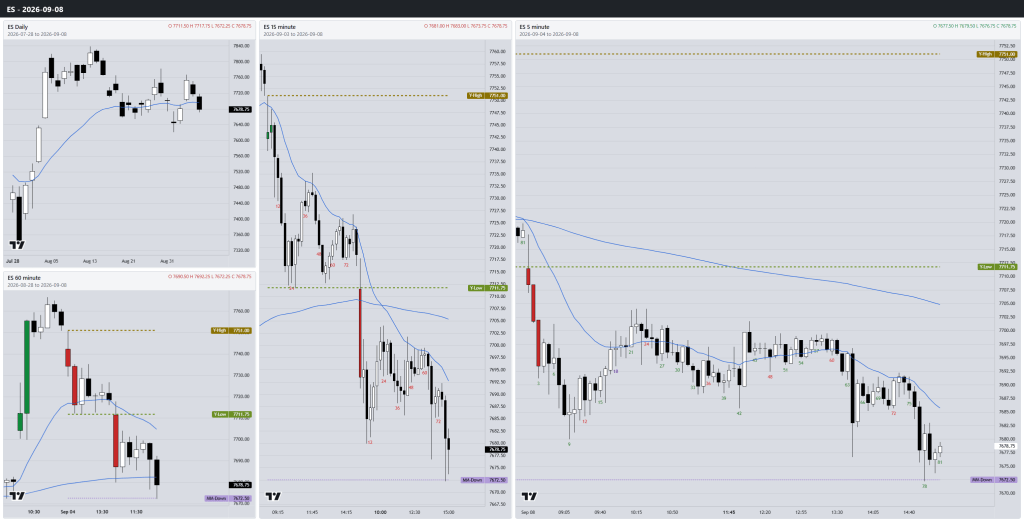
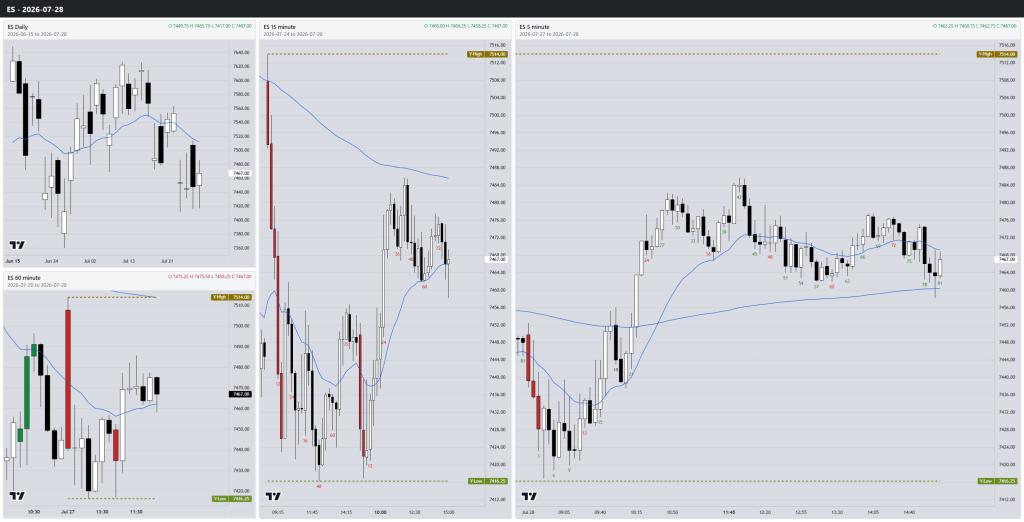
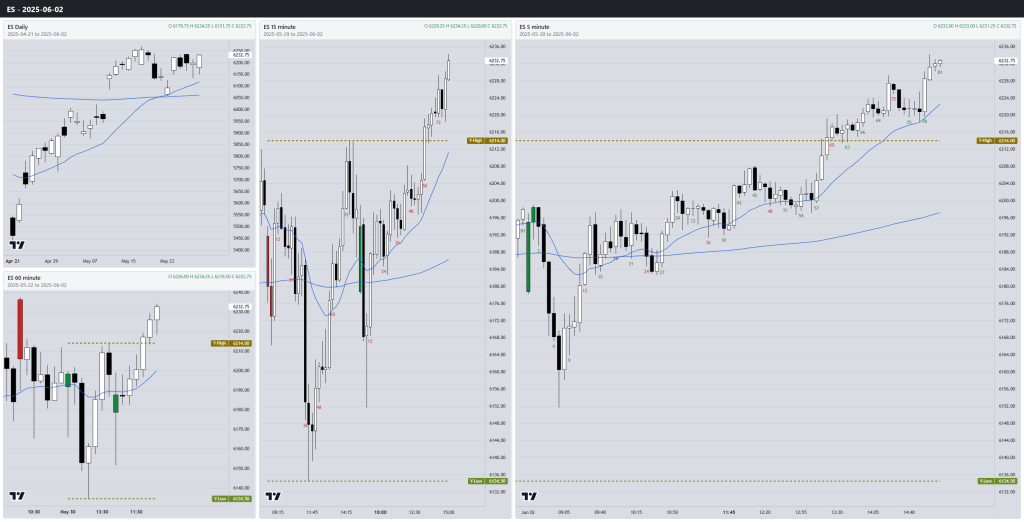
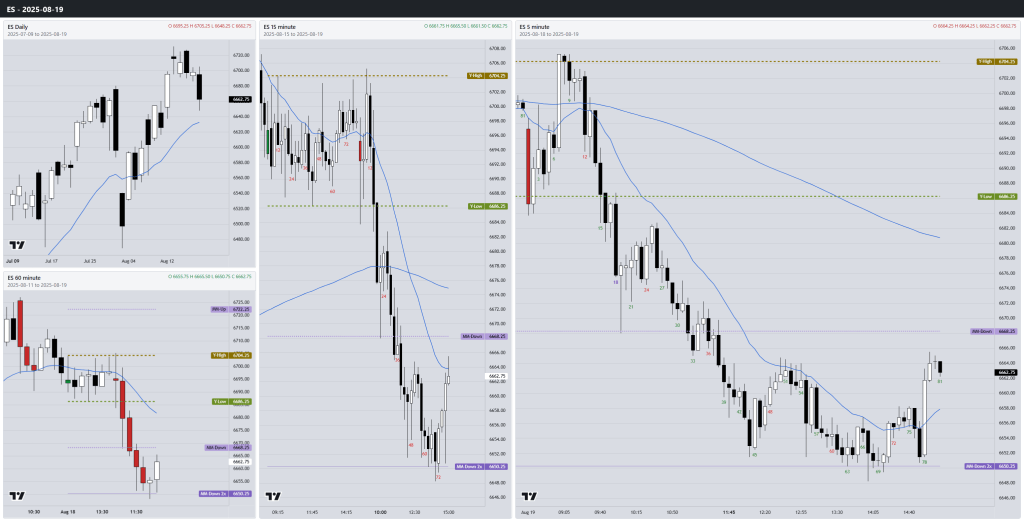
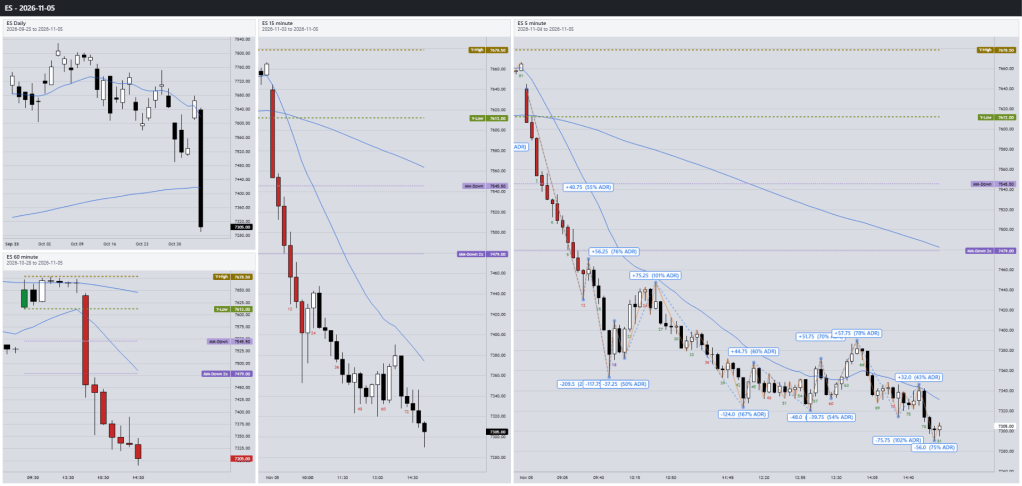
Three days with a down first swing, and three different endings:
First swing up
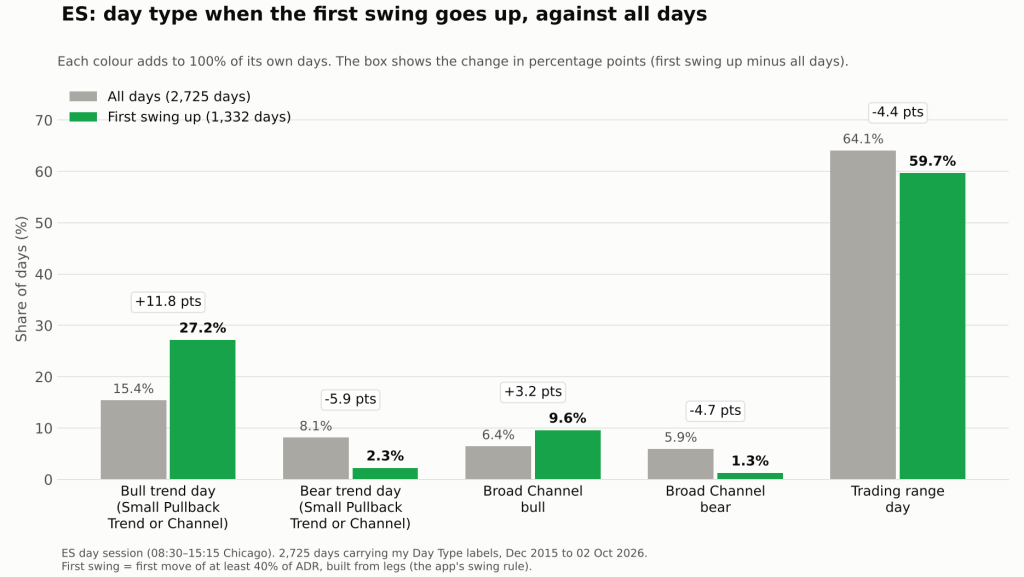
The mirror image, mostly.
- Bull trend day: 27.2%, up from 15.4%.
- Bear trend day: 2.3%, down from 8.1%.
- Trading range day: 59.7%, down from 64.1%.
Here’s the bit that isn’t a mirror. An up first swing lifts the bull trend day from 15.4% to 27.2% of days. A down first swing lifts the bear trend day from only 8.1% to 14.7%. That’s because ES has close to twice as many bull trend days as bear trend days (420 against 222). There are just more bull trend days to find.
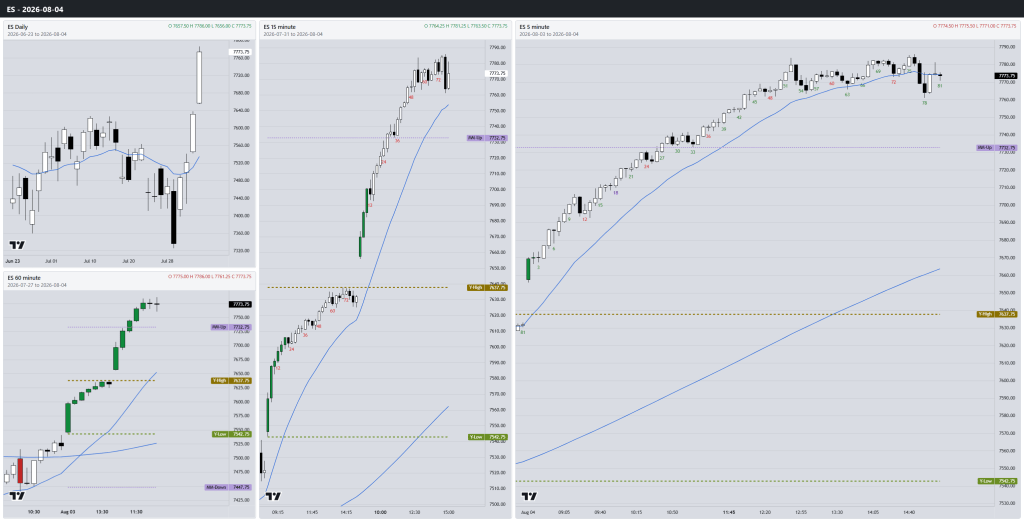
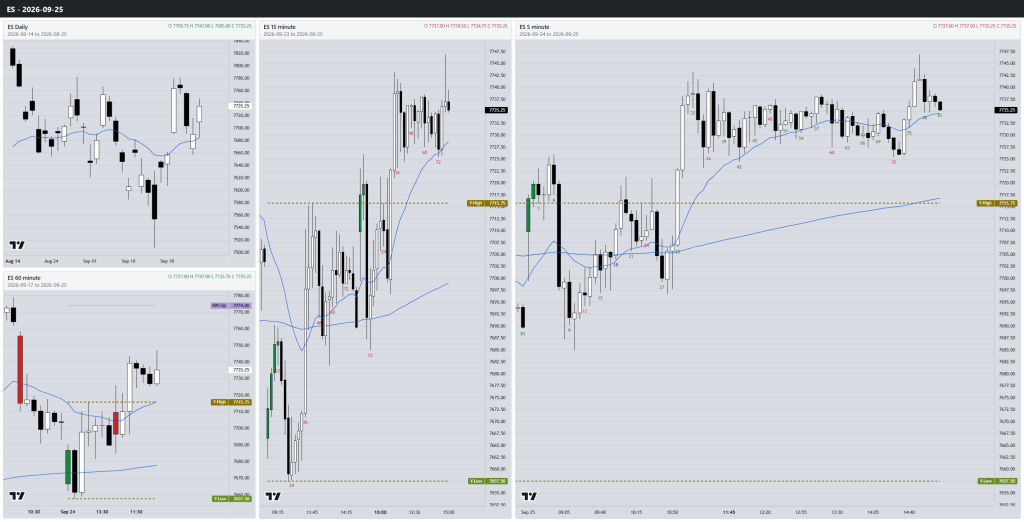
Three days with an up first swing, and three different endings:
No swing at all
90 days never made a 40% of ADR move. 81 of them (90%) were trading range days. The other 9: 3 bull trend days, 1 bear trend day and 5 Broad Channel days.
You only know a day made no swing late in the session. So it’s a check, not an entry. But if the day can’t make one swing, it’s almost always a trading range day.
From the other side
Now flip it. Take every day type and ask which way its first swing went.
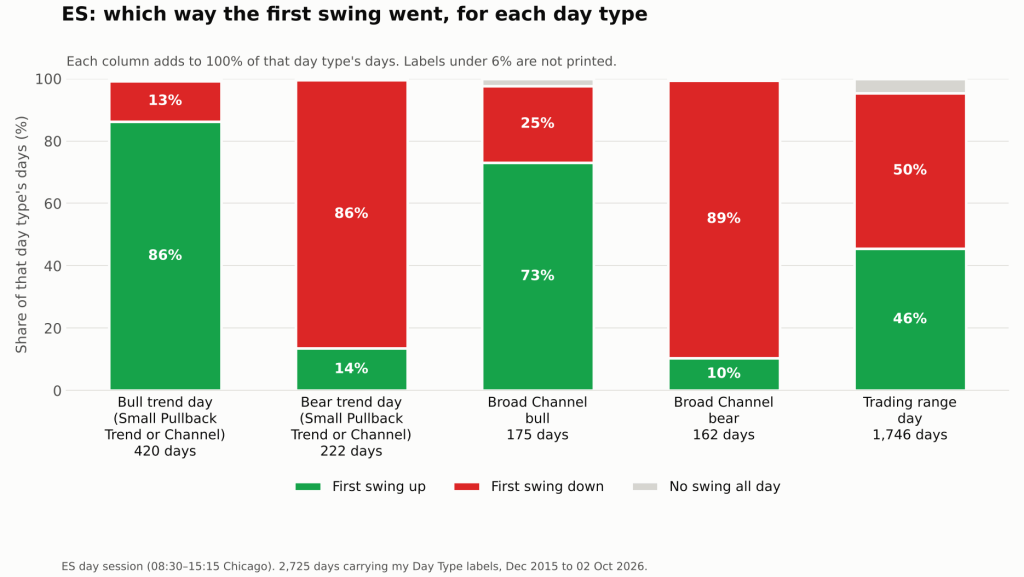
- 86% of bull trend days had an up first swing.
- 86% of bear trend days had a down first swing.
- Trading range days split down the middle: 46% up first, 50% down first.
That last line is the whole post in one number. On a trading range day the first swing goes either way, about half and half. On a trend day it nearly always points the way.
Put bull and bear together and it reads like this. Of the days that made a first swing, a trend day the same way as the first swing happened on 21.0%. A trend day the other way happened on 3.2%.
When do you know?
None of this is any use if the first swing shows up at lunch. So I marked the 5-minute bar where each first swing was confirmed – the bar where price had moved 40% of ADR from where the swing started.
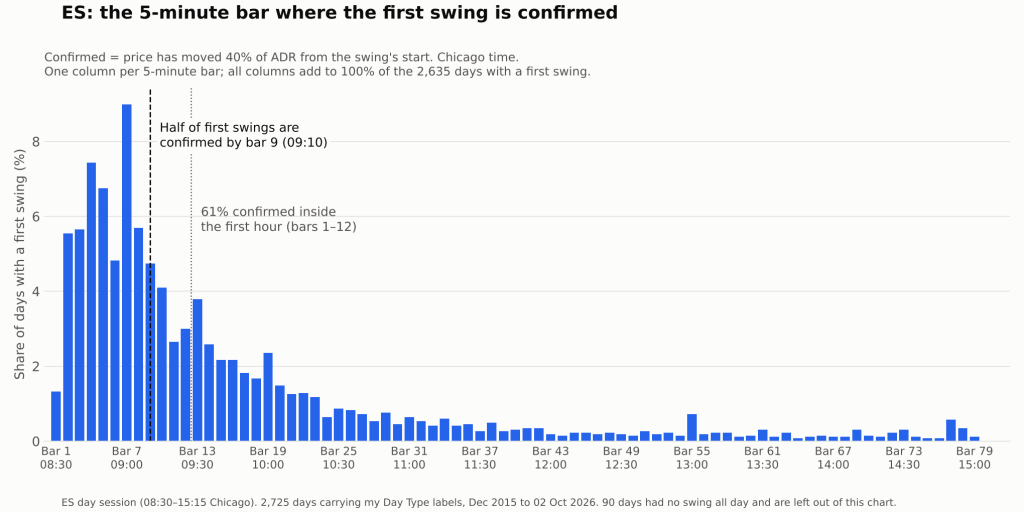
- Half of all first swings are confirmed by bar 9 (09:10 Chicago).
- 61% are confirmed inside the first hour.
- The busiest single bar is bar 7 – 09:00 Chicago, 10:00 New York. 9% of all first swings are confirmed in that one bar. That lines up with the time the US reports come out, but I haven’t checked report days.
A late first swing tells its own story. And it’s different on each side.
- Late down first swing (confirmed 12:30 Chicago or later): 69 days. Not one became a bull trend day. 57 of them (83%) were trading range days.
- Late up first swing: the bull trend day is still alive. In each hour from 11:30 on, 27% to 35% of these days were bull trend days.
- And no up first swing confirmed after 10:30 became a bear trend day. That’s 263 days, and not one.
Caveat: once you split by the hour, each late group holds only 16 to 51 days. Read the day count before the percent.
The days that went the other way
They do happen. Just not often.
- First swing down, then a bull trend day: 55 days. 2.0% of all days. 4.2% of down-first days.
- First swing up, then a bear trend day: 30 days. 1.1% of all days. 2.3% of up-first days.
So the trend day against the first swing is real. It’s about 1 day in 25 after a down first swing. Worth knowing it exists. Not worth expecting.
Most of these 85 days start the same way. On 69 of them (81%), the first swing started in the first hour and finished inside the first 2 hours. Then price came back through where it started, and ran on at least one more first swing size the other way. That’s an opening reversal. It gets its own post next: Half the Moves on the Open Are the Wrong Way?
First swing longer than 2 hours
One more cut. Some first swings start early and just keep going. No 40% of ADR pullback for hours. I call it a first swing longer than 2 hours when it starts by bar 12 (the first hour) and still has had no 40% of ADR pullback at the close of bar 24 (the first 2 hours, 10:30 Chicago).
- 1,251 days. 45.4% of all days.
- 366 (29.3%) were trend days the way of the first swing.
- 13 (1.0%) were trend days the other way. Every one was an opening reversal first.
- 702 (56.1%) were trading range days. The rest were Broad Channel days.
So once the first swing is longer than 2 hours, a trend day from the open the other way is off the table. The 13 days that did trend the other way were all opening reversals: price first went back through where the first swing started (ORRVD or ORV in my Swing Day Type). And none of them had a first swing of 70% of ADR or more by bar 24. Trading range is still the most likely day. But a trend day the same way comes on about 3 days in 10, against 21.0% for all first swings.
Updated 20 November 2026. This section first said “2 days in nearly 11 years”. That count used the whole day: it needed to know where the first swing would top out, which you only find out later. The numbers above are what you can see at the close of bar 24 itself, ES to 17 November 2026. The full study, ES and FDAX: First Swing Longer Than 2 Hours.
Add the gap
In Does a Big Gap Mean a Trading Range Day? the gap direction nearly decided which way a Small Pullback Trend day went. The first swing does much the same here. So which one tells you more? And do they add up?
Same gap as that post: today’s open minus yesterday’s close, as a % of ADR. 14 days opened exactly on yesterday’s close. They’re left out of the gap rows.
Each cell is the % of that row’s days.
| Days | Bull trend | Bear trend | Broad Channel bull | Broad Channel bear | Trading range | |
|---|---|---|---|---|---|---|
| All days | 2,725 | 15.4% | 8.1% | 6.4% | 5.9% | 64.1% |
| Gap up | 1,505 | 20.9% | 5.0% | 5.1% | 6.8% | 62.1% |
| Gap down | 1,206 | 8.5% | 12.2% | 8.0% | 4.9% | 66.3% |
| First swing up | 1,332 | 27.2% | 2.3% | 9.6% | 1.3% | 59.7% |
| First swing down | 1,303 | 4.2% | 14.7% | 3.3% | 11.1% | 66.8% |
| Gap up + up first swing | 726 | 37.3% | 1.1% | 7.0% | 1.5% | 53.0% |
| Gap up + down first swing | 717 | 5.7% | 9.3% | 3.2% | 12.7% | 69.0% |
| Gap down + down first swing | 578 | 2.4% | 21.5% | 3.5% | 9.2% | 63.5% |
| Gap down + up first swing | 600 | 14.8% | 3.7% | 12.7% | 1.0% | 67.8% |
The first swing tells you more than the gap.
- 551 of 640 trend days (86.1%) went the way of the first swing. Only 462 of 640 (72.2%) went the way of the gap.
- On a gap up, a bull trend day is 37.3% of days if the first swing is up. It’s 5.7% if the first swing is down.
But the gap still adds to it.
- Up first swing: a bull trend day is 37.3% of days on a gap up. On a gap down it’s 14.8%, about normal.
- Down first swing: a bear trend day is 21.5% of days on a gap down. On a gap up it’s 9.3%.
When they agree, and when they don’t:
- Same way: 1,304 days. 395 (30.3%) were trend days that way. 22 (1.7%) were trend days the other way. 752 (57.7%) were trading range days.
- Opposite ways: 1,317 days. 156 (11.8%) were trend days the way of the first swing. 63 (4.8%) were trend days the way of the gap. 902 (68.5%) were trading range days.
The gap doesn’t tell you which way the first swing will go. They go the same way on 1,304 of 2,621 days. That’s 49.8%, about half.
On big gaps (50% of ADR or more) the agreement counts for a bit more. Same way: 393 days, and 135 (34.4%) were trend days that way. Opposite ways: 351 days. 33 trend days went with the first swing and 29 went with the gap – close to even. That’s only 62 trend days, so I don’t lean on it hard.
My first idea for the ending was “after all of this, the gap itself tells us.” The data says no. The gap alone tells you less than the first swing. The gap and the first swing together tell you most. When they agree, about 1 day in 3 is a trend day that way. When they disagree, about 2 days in 3 are trading range days.
What I’m taking into the session
- Once the first swing is in, the trend day the other way is close to off the table.
- If the first swing started in the first hour and is longer than 2 hours (no 40% of ADR pullback by bar 24), a trend day from the open the other way is off the table. The other way only comes through an opening reversal: 13 days in nearly 11 years.
- The trend day the same way is still only about 1 day in 5. The first swing doesn’t make a trend day likely.
- Trading range is still the most likely day, whichever way the first swing went.
- If the gap and the first swing agree, I look for the trend day that way. It comes about 1 day in 3.
- If they disagree, I expect a trading range day. That’s about 2 days in 3.
- A down first swing that takes until the afternoon to show up is mostly a trading range day. A late up first swing can still be a bull trend day.
Caveats
- Part of this comes from how the day types are defined. The first swing is still a fair live read, because it shows up early.
- Day types are my own hand labels, so my eyes are in the data.
- I split the dates in half (December 2015 to April 2021, then April 2021 to October 2026). The first swing result holds in both halves. So does the gap plus first swing result.
- The late-session groups are small. Read the day count before the percent.
- ES only in this post.
Conclusion
A down first swing mostly rules out the bull trend day and nearly doubles the bear trend day. An up first swing does the opposite. But neither one makes a trend day likely. About three days in five or more are still trading range days.
Add the gap and the read gets sharper. Gap and first swing the same way: about 1 day in 3 is a trend day that way. Opposite ways: about 2 days in 3 are trading range days. The gap on its own tells you less than the first swing. Together they tell you most.
Here’s a question for you. Pull up yesterday’s chart. Which way did it gap, which way did the first swing go, and what kind of day did it turn into?
Happy trading!
Tim
Zen Trading Tech



Leave a Reply